






What's Happening?
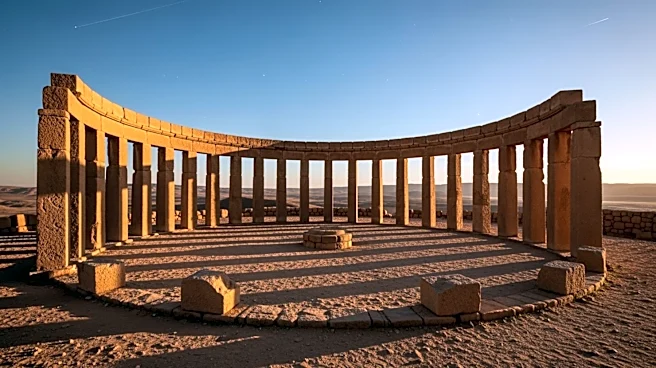
In a significant archaeological discovery, Peru's cultural ministry has announced the unearthing of an ancient astronomical observatory at the settlement of Áspero, part of the Caral civilization. This civilization, dating back to 3000BC-1800BC, is recognized
as the oldest in the Americas. The observatory, strategically located near pyramidal structures, was used to track celestial bodies, aiding in the prediction of weather and tides crucial for fishing and gathering shellfish. The site, directed by archaeologist David Palomino, highlights the Caral's sophisticated understanding of astronomy and its integration into daily life. The observatory's design evolved over time, initially serving as a ceremonial space before being adapted for astronomical purposes.
Why It's Important?
This discovery underscores the advanced nature of the Caral civilization, demonstrating their ability to manage their environment sustainably through a deep understanding of astronomy. It provides insight into how ancient societies used celestial observations to guide economic activities, such as fishing and agriculture, which were vital for their survival. The findings contribute to a broader understanding of pre-Columbian civilizations in the Americas, challenging previous assumptions about the technological and cultural capabilities of these early societies. This could influence current archaeological methodologies and theories regarding the development of complex societies in ancient times.