







What's Happening?
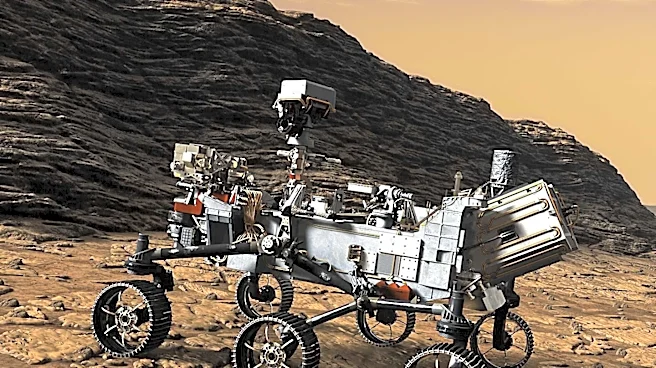
NASA's Spirit rover, which landed on Mars in January 2004, experienced a failure in its right-front wheel in March 2006. Engineers adapted by driving the rover backwards, using the immobile wheel as an excavation tool. This led to the accidental discovery
of bright silica deposits near the volcanic plateau called Home Plate in Gusev Crater. The silica, identified as opaline, suggests ancient hydrothermal activity, possibly from hot springs or steam vents. The discovery required extensive follow-up analysis using various instruments, confirming the presence of silica concentrations up to 90% in some areas.
Why It's Important?
The discovery of silica deposits on Mars is significant as it indicates past hydrothermal conditions, which are known to support microbial life on Earth. This finding contributes to the understanding of Mars' geological history and its potential to have harbored life. The accidental nature of the discovery highlights the importance of adaptability in space exploration missions. The presence of silica, particularly in volcanic regions, provides insights into the planet's environmental conditions and aids in the search for biosignatures, which are crucial for future missions aiming to detect life.
What's Next?
Future Mars missions may focus on areas with similar geological features to further investigate the potential for past life. The findings from Spirit's mission could influence the design and objectives of upcoming rover missions, emphasizing the need for advanced instruments capable of detecting biosignatures. Continued analysis of Spirit's data may refine the understanding of Mars' hydrothermal history, guiding exploration strategies and site selection for sample collection.
Beyond the Headlines
The discovery underscores the role of mechanical failures in scientific breakthroughs, demonstrating how unexpected challenges can lead to significant findings. The silica deposits offer a glimpse into Mars' past, suggesting environments that could have been conducive to life. This raises ethical and scientific questions about the preservation of potential biosignatures and the implications for planetary protection policies as exploration continues.