


What's Happening?
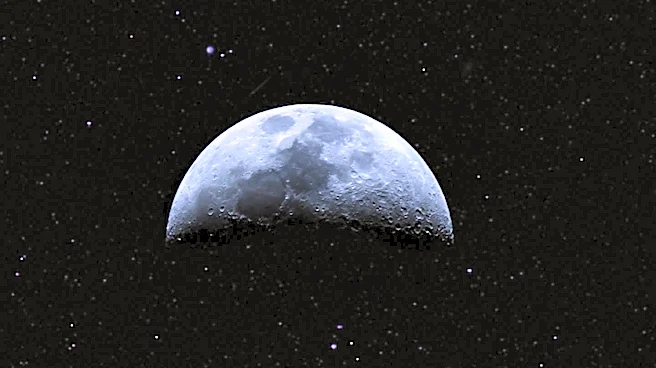
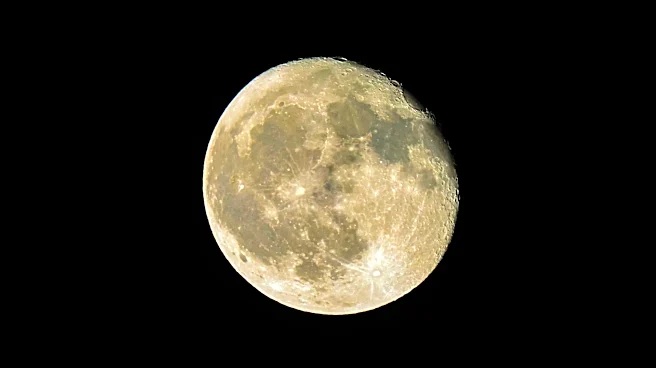
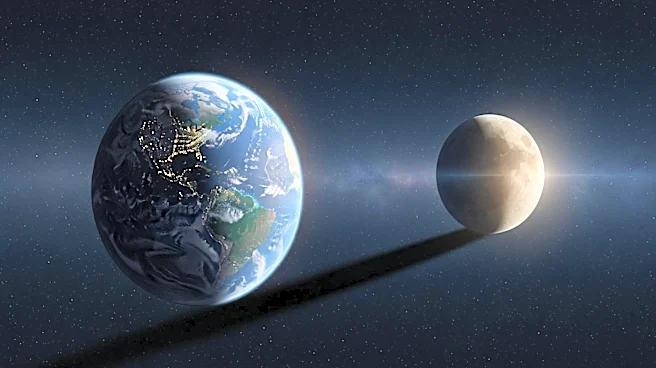
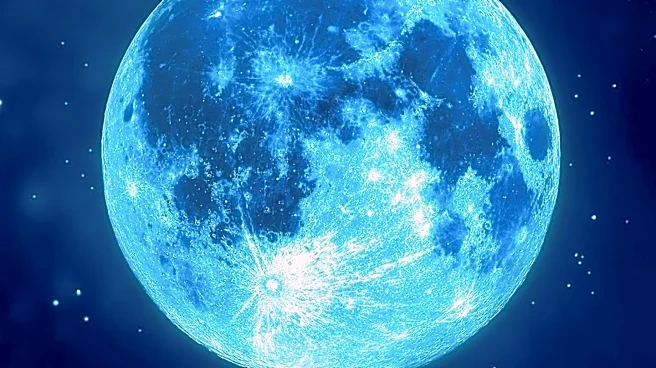
The Earth's rotation is gradually slowing down, resulting in longer days, as the Moon slowly drifts away from the planet. This phenomenon is measured by bouncing lasers off reflectors left on the Moon's surface by Apollo missions, showing the Moon receding
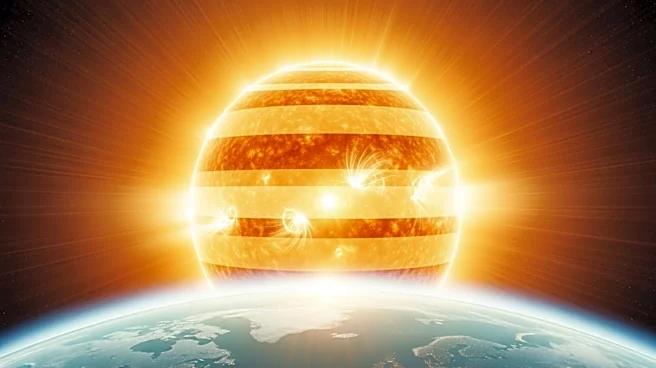
at approximately 3.8 centimeters per year. Historically, Earth's day length was much shorter, estimated to be under 19 hours shortly after the Moon's formation around 4.5 billion years ago. A study published in Nature Geoscience in 2023 suggests that Earth's day remained at roughly 19 hours for about a billion years during the mid-Proterozoic era due to a balance between lunar ocean tides slowing Earth's spin and atmospheric tides driven by the Sun's heating speeding it up.
Why It's Important?
The gradual lengthening of Earth's day and the Moon's recession have significant implications for understanding Earth's geological and climatic history. The changes in Earth's rotation and the Moon's orbit affect tidal patterns, which in turn influence ocean currents and climate systems. This knowledge helps scientists predict future changes in Earth's environment and contributes to our understanding of planetary dynamics. The precise measurement of the Moon's distance from Earth also enhances our understanding of celestial mechanics and the long-term evolution of the Earth-Moon system.
What's Next?
Future research will likely focus on refining the models of Earth's rotational dynamics and the Moon's orbital changes. Scientists may continue to study geological records to better understand the historical interactions between Earth's rotation and climate. Additionally, ongoing laser measurements will provide more data to track the Moon's recession and its effects on Earth. These studies could inform predictions about future changes in Earth's day length and their potential impacts on global climate and sea levels.
Beyond the Headlines
The interaction between Earth's rotation and the Moon's orbit highlights the complex interplay of gravitational forces in our solar system. This phenomenon underscores the importance of conservation laws, such as the conservation of angular momentum, in understanding celestial mechanics. The study of these processes also provides insights into the history of our planet and its natural satellites, offering a broader perspective on the evolution of planetary systems.