







What's Happening?
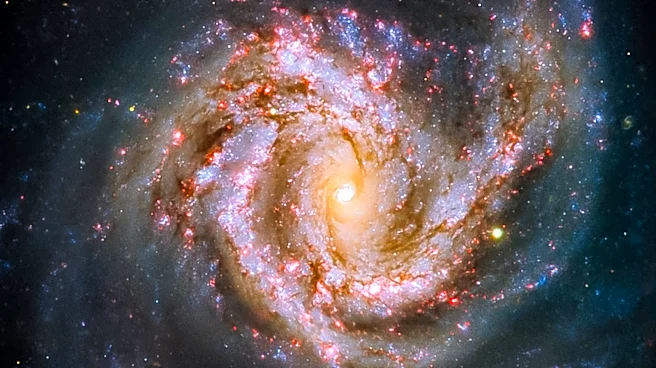
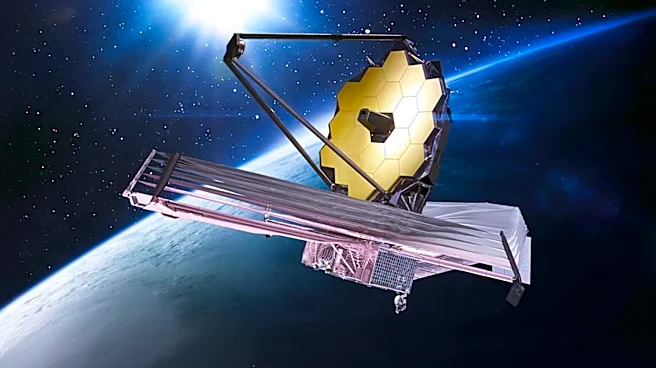
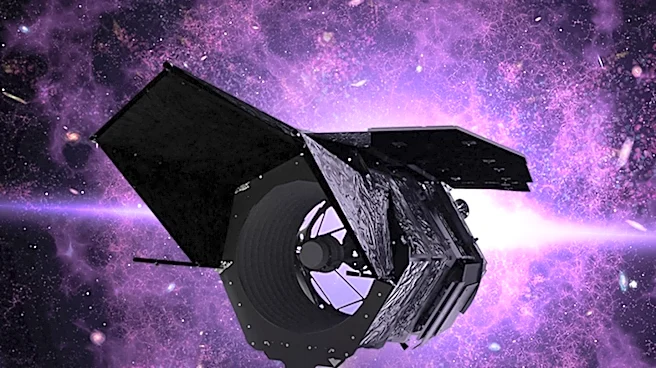
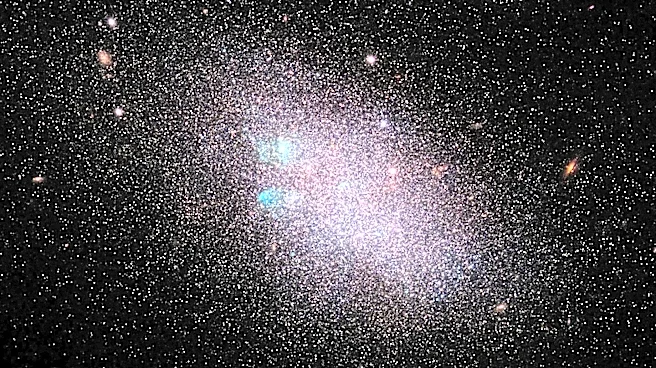
The James Webb Space Telescope has observed the dwarf galaxy Sextans A, which is notably poor in heavy elements, producing dust from silicon carbide and potentially metallic iron. This discovery challenges previous assumptions that early galaxies would
struggle to produce such materials due to their low metallicity. The study, led by Martha Boyer of the Space Telescope Science Institute, focused on six asymptotic giant branch (AGB) stars within the galaxy. These stars, in a late stage of evolution, shed their outer layers, allowing atoms and molecules to condense into microscopic solids. The findings suggest that even in environments with low metal abundance, stars can still produce significant amounts of dust.
Why It's Important?
This discovery is significant as it provides new insights into the processes of dust formation in low-metallicity environments, which are thought to resemble conditions in the early universe. Understanding how dust is produced in such environments can help astronomers refine models of galaxy evolution and the lifecycle of stars. The presence of dust in early galaxies is crucial for the formation of planets and stars, and this study suggests that even galaxies with limited heavy elements can contribute to this process. The findings could lead to a reevaluation of how dust production is accounted for in models of the early universe.
What's Next?
Further observations are needed to determine if the dust production processes observed in Sextans A are common in other low-metallicity galaxies. The study's authors call for additional research on a larger population of massive, metal-poor AGB stars to better understand their contribution to dust budgets in galaxies. This could potentially lead to new insights into the role of such stars in the early universe and their impact on galaxy formation and evolution.
Beyond the Headlines
The study highlights the complexity of dust production in galaxies and the potential for stars to create dust even in environments with limited resources. This challenges the traditional view that high metallicity is necessary for significant dust production. The findings also underscore the importance of advanced telescopes like the James Webb Space Telescope in uncovering new aspects of cosmic phenomena that were previously not well understood.