


What's Happening?
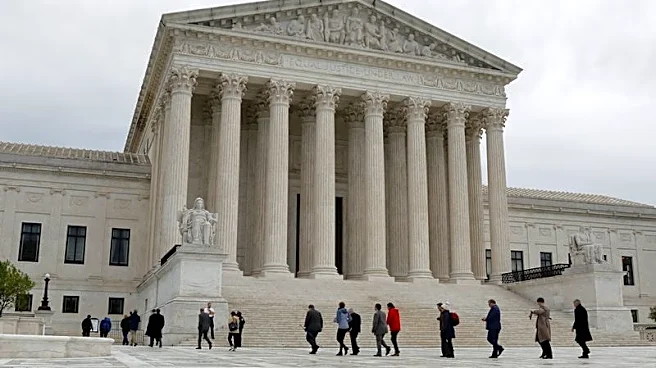
Justice Amy Coney Barrett recently recused herself from the U.S. Supreme Court case, Oklahoma Statewide Charter School Board v. Drummond, which concerned the constitutionality of opening a Catholic charter school. Her recusal led to a 4-4 deadlock among
the remaining justices, effectively upholding lower court rulings that blocked the school. These lower court decisions in Oklahoma determined that state funding for a religious school would violate both Oklahoma law and the First Amendment to the U.S. Constitution. This development follows a broader trend of legal challenges regarding the extent to which public aid can be provided to faith-based institutions under the First Amendment's establishment clause. Currently, a new case involving Ben Gamla, a Jewish organization whose application for a charter school in Oklahoma was denied, is proceeding in federal court. This organization seeks to establish a school offering both secular and religious education, further testing the boundaries of religious charter schools in the U.S.
Why It's Important?
This Supreme Court deadlock and the ongoing Ben Gamla litigation highlight a significant and evolving debate over the separation of church and state in American education. The issue directly impacts public policy regarding charter schools and the allocation of taxpayer money. The Supreme Court's increasingly favorable stance towards faith-based schools, as evidenced by recent rulings like Trinity Lutheran v. Comer (2017), Espinoza v. Montana Department of Revenue (2020), and Carson v. Makin (2022), suggests a potential shift in how the First Amendment's establishment and free exercise clauses are interpreted. These cases have expanded the permissible scope of aid to religious institutions, challenging long-standing state constitutional provisions that prohibit public funds for religious entities. The outcome of cases like Ben Gamla could set new precedents for religious charter schools nationwide, influencing educational models and funding structures, and potentially altering the landscape of public education by allowing more faith-based institutions to receive public support.
What's Next?
The federal court judge's decision to allow Ben Gamla's suit to proceed means the underlying constitutional questions regarding religious charter schools will be further examined. Oklahoma has a 30-day window to appeal this judgment to the 10th Circuit. Legal experts anticipate that this case, similar to the previous Catholic charter school dispute, could eventually reach the Supreme Court. The trial court judge in the Ben Gamla case specifically cited recent Supreme Court decisions that support arguments for aid to faith-based schools, which may strengthen the likelihood of a different outcome compared to the St. Isidore of Seville Catholic Virtual School case. The progression of this litigation will be closely watched by stakeholders on both sides of the church-state separation debate, as it could significantly influence the future of religious education and public funding in the United States.
Beyond the Headlines
The ongoing legal battles over religious charter schools delve into profound ethical and cultural dimensions concerning the role of religion in public life and education. The tension between the First Amendment's establishment clause, which prohibits government endorsement of religion, and the free exercise clause, which protects religious practice, is at the heart of these disputes. A shift towards allowing more public funding for religious schools could lead to a re-evaluation of the secular nature of public education and potentially impact the diversity and inclusivity of educational offerings. It also raises questions about accountability and oversight for publicly funded religious institutions. The long-term implications could include a more integrated model of religious and secular education, potentially leading to increased calls for similar funding for other faith-based initiatives, thereby reshaping the traditional boundaries between religious institutions and government support in the U.S.