
What's Happening?
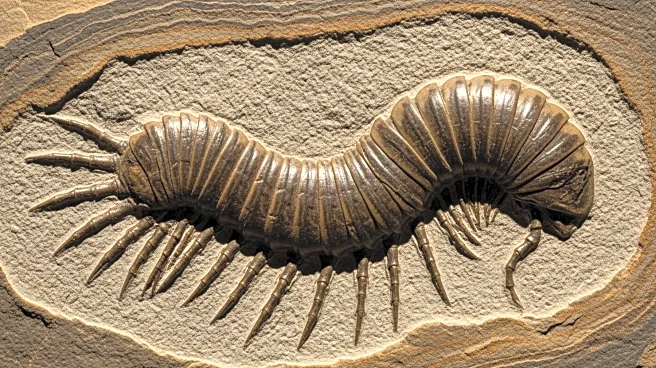
A fossil of a giant millipede, Arthropleura, has been discovered in a sandstone boulder on a beach in northern England, revealing it as the largest land invertebrate in Earth's history. The fossil, measuring
75 centimeters, is part of a creature that could grow up to 2.7 meters in length and weigh around 50 kilograms. This discovery, dating back 326 million years to the Carboniferous period, challenges previous assumptions about prehistoric arthropods and their environments. The fossil was found in a fossilized river channel, suggesting that Arthropleura thrived in open woodlands rather than coal swamps, feeding on decaying vegetation and possibly small invertebrates.
Why It's Important?
The discovery of the Arthropleura fossil provides new insights into the evolution and ecology of prehistoric arthropods. It challenges the long-held belief that high atmospheric oxygen levels were the primary driver of gigantism in Paleozoic arthropods, suggesting instead that factors like abundant nutrition and stable climates played significant roles. This finding reshapes our understanding of ancient ecosystems and the conditions that supported large-bodied invertebrates. The fossil also highlights the dynamic nature of prehistoric environments, where giant invertebrates thrived across vast open woodlands.
Beyond the Headlines
The discovery of Arthropleura raises questions about the factors that led to its extinction during the early Permian period. Climate shifts that resulted in drier conditions may have reduced their habitat and breeding cycles, while the rise of early reptiles could have introduced competition for resources. The absence of full body fossils limits researchers' ability to fully reconstruct the behavior and biology of these creatures, but the discovery offers a rare glimpse into a world where giant invertebrates dominated the landscape.