

What's Happening?
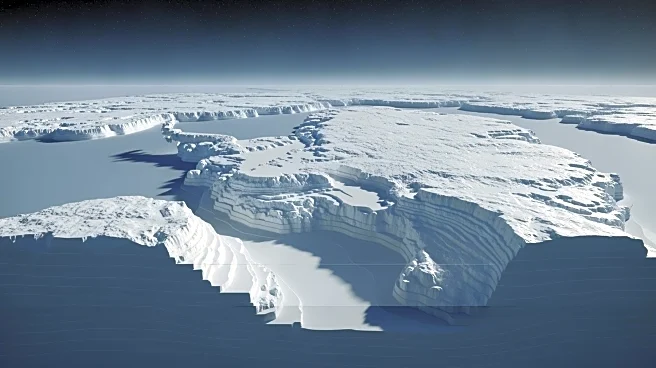
Scientists have created the most detailed map to date of Antarctica's subglacial topography, revealing thousands of previously unknown features beneath miles of ice. This groundbreaking research, published in Science, utilized satellite observations and physics
modeling to provide unprecedented detail of the continent's hidden landscape. The study identified numerous hills, ridges, and clarified images of buried mountain ranges and canyons. A significant discovery was a deep channel in the Maud Subglacial Basin, measuring approximately 50 meters deep, 6 kilometers wide, and nearly 400 kilometers long. This new map fills gaps left by previous radar surveys, offering a clearer picture of Antarctica's bedrock and its potential impact on global sea-level rise.
Why It's Important?
Understanding Antarctica's hidden terrain is crucial as these formations influence the speed at which glaciers flow and retreat, particularly as global temperatures rise. The melting of Antarctic ice contributes significantly to rising sea levels, posing threats to coastal populations, drinking water supplies, and infrastructure. The detailed mapping of these subglacial features helps improve models that predict future environmental conditions, which is vital for planning and mitigating the impacts of climate change. As Antarctic ice loss remains one of the largest uncertainties in climate projections, this research provides essential data to better understand and prepare for potential global impacts.
What's Next?
The new map will aid researchers in refining predictions about how quickly Antarctic ice will contribute to sea-level rise. This information is critical for policymakers and communities worldwide to develop strategies to mitigate and adapt to the impacts of climate change. Further research will likely focus on monitoring changes in these subglacial features over time to assess their influence on glacier dynamics and sea-level rise. The study's findings may also prompt increased international collaboration to address the challenges posed by climate change and its effects on global sea levels.