



What's Happening?
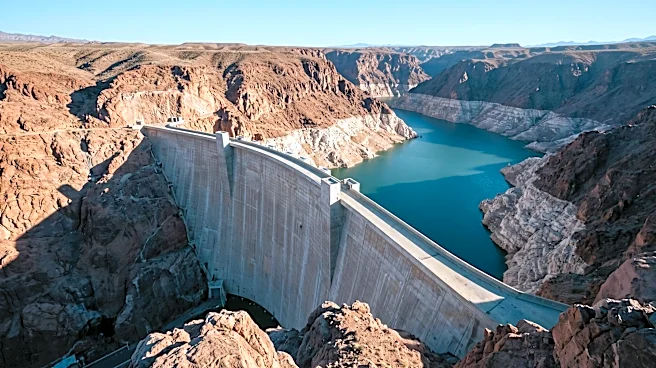
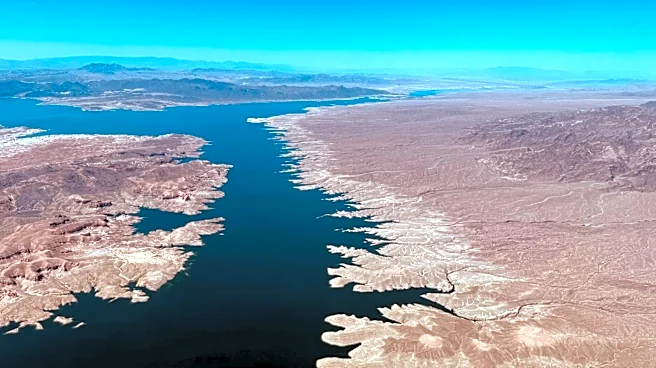
Nevada officials have filed a lawsuit against the federal government, challenging its new plan for managing water shortages on the Colorado River. The plan, adopted in July, imposes significant mandatory water cuts on the Lower Basin states of Nevada,
Arizona, and California, while making no cuts to the Upper Basin states. Nevada argues that the federal plan illegally forces it to bear too much of these cuts, potentially leading to a 71% reduction in the Las Vegas area's water supply in a worst-case scenario. The state claims this outcome stems from a misreading of the law and that the federal government failed to consider important alternatives or adequately assess the environmental, socioeconomic, and human impacts on southern Nevada.
Why It's Important?
This lawsuit marks a significant shift in Nevada's long-standing role as a conciliator in Colorado River negotiations, signaling its determination to protect its water resources. The potential 71% cut to Las Vegas's water supply is described as 'existential' for the region, which relies on the Colorado River for 90% of its water and has been a model for urban water conservation. The legal challenge highlights the deep divisions among the basin states and the federal government's struggle to create a universally accepted long-term solution for the declining river. The outcome of this lawsuit could set a precedent for how water rights and shortages are managed across the entire Colorado River Basin, impacting millions of people and vast agricultural and urban areas.
What's Next?
Nevada's lawsuit calls for an injunction to prevent the implementation of the 2027–2036 Colorado River Guidelines. While Nevada has not yet requested an immediate restraining order, a favorable ruling for the state could disrupt the initial two-year arrangement designed to stabilize Lower Basin states. The legal process will likely involve intense scrutiny of the federal government's decision-making process under the National Environmental Policy Act (NEPA) and its consideration of alternatives. Experts suggest that while this lawsuit is significant, it may not be the 'cannonball-splash' litigation feared by some, which would challenge the 1922 Colorado River Compact. However, it adds considerable uncertainty to the river's near-term operations and could influence future negotiations among the basin states.
Beyond the Headlines
The lawsuit underscores the escalating crisis of water scarcity in the American West, driven by overuse and climate change-exacerbated drought. It brings to light the complex legal and political frameworks governing shared natural resources, particularly the 'Law of the River' and the challenges of equitable allocation among diverse stakeholders. The case also highlights the unique vulnerability of urban centers like Las Vegas, which are heavily dependent on a single water source, compared to states with more diversified water portfolios or significant agricultural sectors that can absorb cuts by fallowing fields. This legal battle could force a reevaluation of long-term water management strategies, potentially leading to innovative solutions or, conversely, further entrenching conflicts over dwindling resources.