




What's Happening?
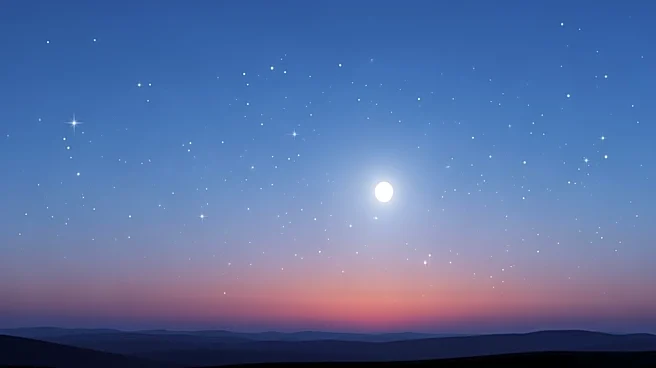
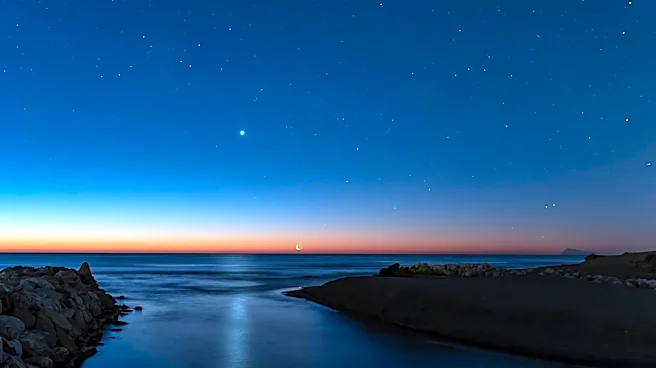
Venus, often referred to as the 'Evening Star,' is currently visible in the evening sky, shining brighter than any star and second only to the moon. This celestial event occurs as Venus reflects sunlight, making it a prominent feature in the western sky shortly
after sunset. The planet will continue to climb higher and shine more intensely throughout the summer, reaching its peak brightness in mid-September. Venus follows a synodic cycle of approximately 584 days, alternating between its appearances as the 'Morning Star' and the 'Evening Star.' During this period, Venus transitions through phases similar to the moon, from a bright, rounded glow to a crescent. This phenomenon is visible without any special equipment, although binoculars or a small telescope can enhance the viewing experience.
Why It's Important?
The visibility of Venus as the 'Evening Star' offers a unique opportunity for both amateur and professional astronomers to observe one of the brightest celestial bodies in the sky. This event not only provides a chance for educational engagement with astronomy but also enhances public interest in space and planetary science. The predictable cycle of Venus's visibility can serve as a tool for teaching about planetary motion and the solar system's dynamics. Additionally, such celestial events can inspire cultural and artistic expressions, drawing connections between science and the humanities.
What's Next?
As Venus continues its journey across the evening sky, it will gradually climb higher and linger longer each night, making it increasingly easier to spot. By mid-September, Venus will reach its peak brightness, offering an even more spectacular view. Following this period, Venus will begin to fade as it moves closer to the sun from Earth's perspective, eventually disappearing into the sun's glare by October. It will then transition into its next phase as the 'Morning Star' in early 2027, providing another opportunity for observation and study.