










What's Happening?
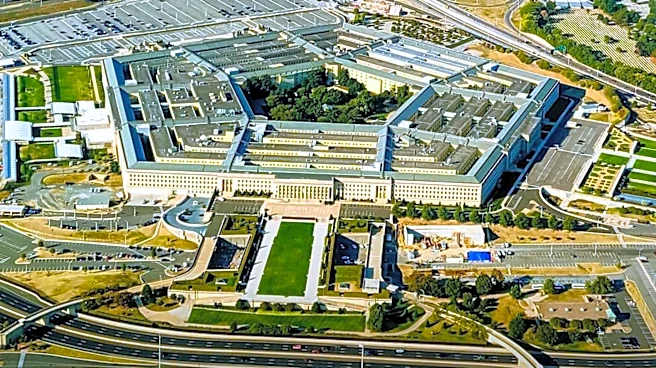
The Pentagon has announced the development of a new agentic-AI tool, known as Agent Network, designed to provide U.S. military commanders with rapid targeting options. This tool employs AI 'agents' to continuously scan intelligence feeds and operational
networks, translating findings into actionable options for commanders. The system ensures that human decision-makers remain in control, as it does not autonomously select or strike targets. The Agent Network is part of a broader Pentagon AI strategy, involving key contractors like Lumbra and Palantir. Despite its potential, there are concerns about the complexity and governance of AI agents, as well as the risks associated with their deployment.
Why It's Important?
The introduction of the Agent Network represents a significant advancement in military technology, potentially enhancing the speed and accuracy of military operations. By providing commanders with rapid targeting options, the tool could improve decision-making processes and operational efficiency. However, the deployment of such advanced AI systems also raises concerns about oversight and the potential for errors. The balance between leveraging AI capabilities and ensuring human control is crucial to prevent unintended consequences. The success of this tool could influence future military strategies and the integration of AI in defense operations.
What's Next?
As the Agent Network is deployed, the Pentagon will need to address challenges related to the governance and monitoring of AI agents. Ensuring that these systems operate within safe and ethical boundaries will be essential. The military may also explore further applications of AI in defense, potentially expanding the use of agentic-AI tools. Ongoing evaluation and adaptation of these technologies will be necessary to maximize their benefits while minimizing risks.