

What's Happening?
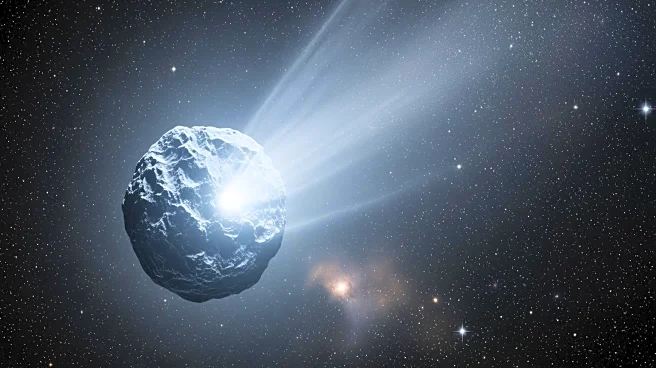
NASA's ongoing observations of Comet 3I/ATLAS, an interstellar visitor, have yielded significant scientific insights. As of December 24, 2025, the comet is moving away from Earth, positioned approximately 1.81 astronomical units (AU) from our planet and
2.44 AU from the Sun. Recent studies, including a Breakthrough Listen radio search using the Robert C. Byrd Green Bank Telescope, have found no artificial radio signals emanating from the comet, suggesting it is a natural celestial body. The comet's unique features, such as its sunward-facing 'anti-tail' and wobbling jet behavior, continue to intrigue scientists. Observations have detected hydrogen cyanide and methanol in the comet's composition, though NASA assures there is no threat to Earth due to the comet's considerable distance.
Why It's Important?
The study of Comet 3I/ATLAS is crucial as it provides a rare opportunity to analyze an interstellar object, offering insights into the composition and behavior of bodies formed outside our solar system. The absence of artificial signals supports the natural origin of the comet, contributing to our understanding of interstellar objects. The detection of cyanide compounds, while scientifically significant, poses no danger to Earth, dispelling public concerns. The comet's unique features, such as its anti-tail and jet behavior, offer new data on cometary physics, potentially enhancing our knowledge of comet formation and evolution. This research could inform future strategies for observing and potentially intercepting interstellar objects.
What's Next?
As Comet 3I/ATLAS continues its journey out of the inner solar system, it remains a subject of scientific interest. NASA plans to continue monitoring the comet with various instruments, including the Hubble Space Telescope and the James Webb Space Telescope, to gather more data. The comet is expected to remain observable with telescopes into spring 2026. The scientific community is also discussing the development of rapid-response strategies for future interstellar visitors, emphasizing the need for pre-planned interceptors to study such objects more closely. This ongoing research will likely contribute to the broader understanding of interstellar phenomena and the potential for future discoveries.
Beyond the Headlines
The study of Comet 3I/ATLAS highlights the importance of international collaboration in space exploration, as multiple observatories and space agencies contribute to the data collection and analysis. The comet's journey through our solar system serves as a reminder of the dynamic nature of space and the potential for unexpected discoveries. The ethical considerations of space exploration, such as the search for extraterrestrial life and the implications of detecting artificial signals, continue to be topics of discussion within the scientific community. This event underscores the need for continued investment in space research and technology to enhance our understanding of the universe.