



What's Happening?
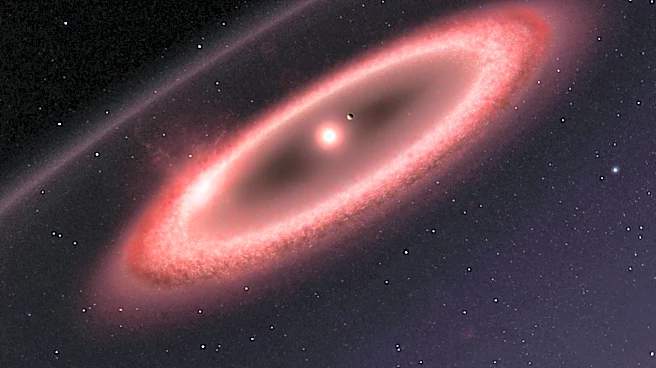
Astronomers, led by a Harvard team including Edo Berger and Kevin Ortiz Ceballos, have achieved a historic milestone by directly detecting radio emissions from an exoplanet outside our solar system for the first time. The signals originate from Beta Pictoris
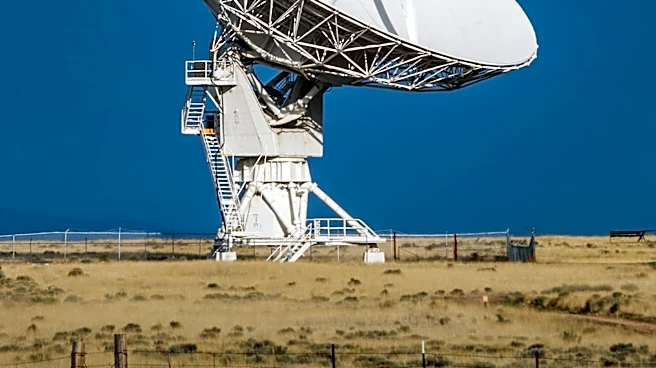
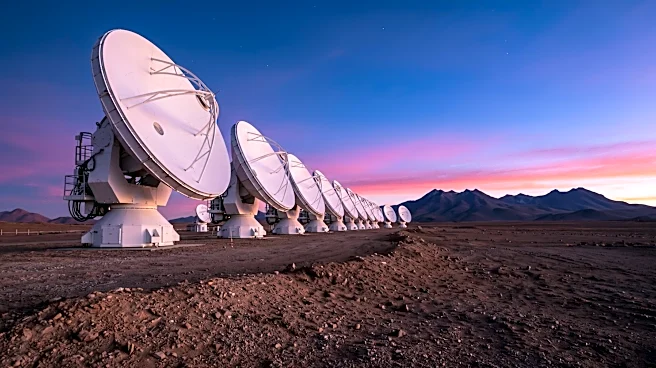
b, a young gas giant approximately 63 light-years from Earth, with an estimated mass 12 times that of Jupiter. The detection, made using the MeerKAT radio telescope array in South Africa, provides direct observational proof of an immense planetary magnetic field. These repeating, strongly circularly polarized radio bursts were detected across frequency bands between 0.85 GHz and 3.5 GHz. The magnetic field intensity of Beta Pictoris b is measured at least 1.25 kilogauss, over 200 times stronger than Jupiter's. The radio signals are generated by massive auroral storms, similar to Earth's Northern and Southern Lights, where high-energy charged particles trapped within the planet's magnetic field lines accelerate and produce intense bursts of coherent radio waves.
Why It's Important?
This discovery is profoundly important as it marks the first direct detection of radio signals from an exoplanet, offering a new method for studying distant worlds. Planetary magnetic fields are crucial for protecting atmospheres from stellar winds and cosmic radiation, making their detection vital for assessing atmospheric stability and interior planetary structures. The ability to directly measure these fields provides a powerful tool for understanding the potential habitability of exoplanets. The high-frequency radio waves observed from Beta Pictoris b challenge conventional models, which assumed exoplanetary magnetic fields would produce emissions at much lower frequencies. This finding necessitates a re-evaluation of existing theories about exoplanetary magnetospheres and their interaction with their host stars, significantly advancing the field of exoplanet characterization.
What's Next?
The successful detection of radio signals from Beta Pictoris b opens new avenues for exoplanet research. Future efforts will likely focus on applying this detection method to other exoplanets to identify and characterize their magnetic fields. This could lead to a catalog of exoplanetary magnetic field strengths, providing crucial data for comparative planetology. Researchers will also work to refine theoretical models to better explain the high-frequency emissions observed from Beta Pictoris b. Continued observations of this system and others will help to understand the dynamics of auroral storms on gas giants and their role in planetary evolution. This breakthrough could also inform the search for biosignatures, as a strong magnetic field is considered a prerequisite for maintaining a stable atmosphere capable of supporting life.
Beyond the Headlines
Beyond its scientific implications, this discovery subtly shifts our perspective on the universe's 'soundscape.' While the radio signals are natural and not indicative of extraterrestrial intelligence, they represent a form of cosmic communication from distant worlds, albeit non-sentient. This expands our sensory understanding of the cosmos, moving beyond visual observations to include electromagnetic emissions that reveal fundamental planetary processes. The sheer power of Beta Pictoris b's magnetic field and its auroral activity underscores the extreme and dynamic nature of exoplanetary environments, contrasting with the more familiar conditions within our solar system. This ongoing exploration of exoplanets continues to broaden our cosmic imagination and our place within a vast and diverse universe.