
What's Happening?
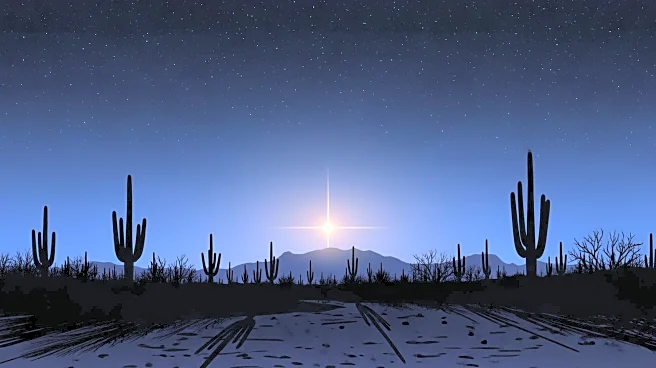
On January 6, 2026, stargazers in Arizona have the opportunity to view Regulus, the brightest star in the constellation Leo, as it appears slightly above the rising moon. Regulus, also known as Alpha Leonis,
is located about 79 light-years from Earth and is notable for its position on the ecliptic, the plane along which the sun, moon, and planets move. This alignment has historically made Regulus significant in both observational astronomy and ancient sky calendars. The star is a blue-white main-sequence star, nearly four times the mass of the sun and over 300 times as luminous. The optimal viewing time for Regulus is around 8:50 p.m. local time. In some regions, including parts of eastern Europe, Asia, and Russia, the moon will pass in front of Regulus in an event known as an occultation.
Why It's Important?
The visibility of Regulus offers a unique opportunity for both amateur and professional astronomers to observe a star that has played a significant role in the history of astronomy. Its position on the ecliptic makes it a key reference point for celestial navigation and timekeeping. The event also highlights the ongoing interest in astronomical phenomena and the public's engagement with science and space exploration. For Arizona residents, this celestial event provides a chance to connect with the broader universe and appreciate the natural wonders visible from Earth. Additionally, such events can inspire educational initiatives and public interest in astronomy, potentially influencing future scientific endeavors and careers.
What's Next?
Following the visibility of Regulus, 2026 is expected to be a year filled with significant lunar events, including a total lunar eclipse in March and a partial lunar eclipse in August. These events will continue to draw attention to the night sky and provide further opportunities for public engagement with astronomy. Educational institutions and observatories may organize viewing events and educational programs to capitalize on these celestial occurrences. The continued interest in astronomical events could lead to increased funding and support for space exploration and research initiatives.