





What's Happening?
Researchers at the University of California, Riverside, have developed a machine learning-based method to identify chemical compounds that can safely repel honey bees from pesticide-treated crops. This research, funded by a grant from the California Research Alliance
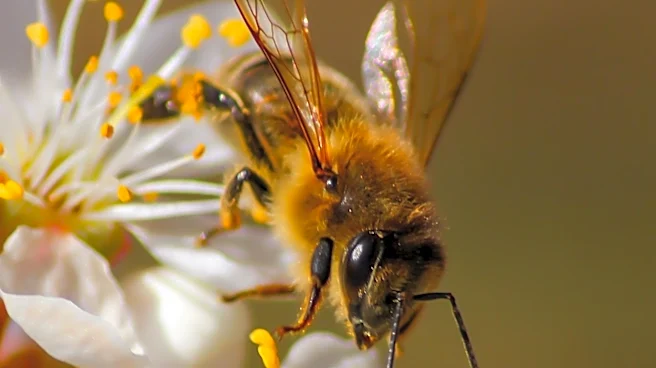
by BASF, addresses the critical issue of declining honey bee populations due to pesticide exposure. The interdisciplinary team, led by Professor Anandasankar Ray, focused on the complex olfactory system of honey bees to find scents that would deter them without causing harm. Their machine learning model, trained on chemical structures and bee behavioral responses, screened over 50 million compounds, identifying approximately 130 with strong repellent potential. Laboratory and field tests confirmed that seven top-performing candidates effectively repelled bees from honeycombs without adverse effects.
Why It's Important?
The decline in honey bee populations poses a significant threat to U.S. agriculture and the broader ecosystem, as these pollinators are essential for the production of many crops. Pesticide exposure is a major contributing factor to this decline. This new machine learning method offers a promising solution by providing a way to protect bees from harmful chemicals while still allowing farmers to use necessary pest control measures. By safely repelling bees from treated areas, the technology could help mitigate colony collapse disorder, improve crop yields, and support the sustainability of agricultural practices. This innovation has the potential to benefit both the agricultural industry and environmental conservation efforts across the nation.
What's Next?
The next steps involve further development and testing of the identified repellent compounds to ensure their long-term efficacy and safety in various agricultural settings. Researchers will likely work towards scaling up production of these compounds and integrating them into existing pest management strategies. Collaboration with agricultural organizations and regulatory bodies will be crucial for widespread adoption. The success of this method could pave the way for similar machine learning applications in pest control, leading to more targeted and environmentally friendly solutions for protecting beneficial insects while managing agricultural pests.
Beyond the Headlines
This research highlights the growing role of artificial intelligence and machine learning in addressing complex ecological challenges. By leveraging computational power to analyze vast datasets, scientists can accelerate the discovery of solutions that would be difficult or impossible to achieve through traditional methods. The ethical implications of manipulating insect behavior, even for protective purposes, will also be an important consideration as this technology advances. Furthermore, this development underscores the interconnectedness of technology, agriculture, and environmental health, demonstrating how innovative scientific approaches can contribute to sustainable practices and biodiversity conservation.