

What's Happening?
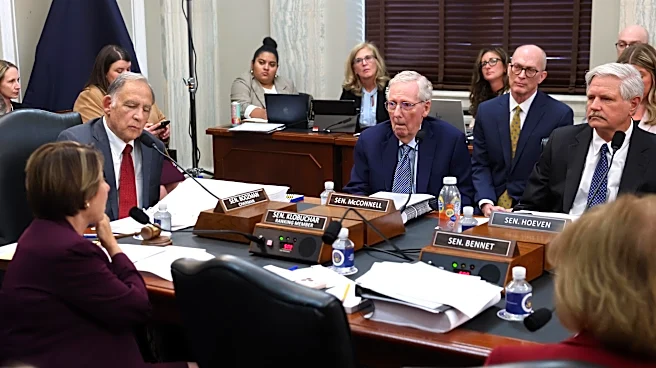
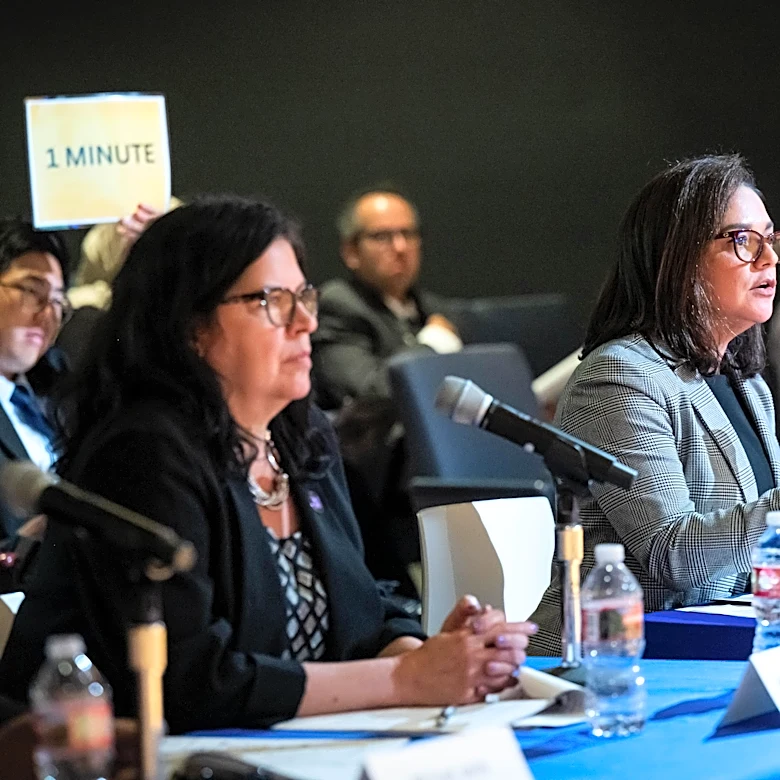
Ranking Member Valerie Foushee (D-NC) of the Subcommittee on Space and Aeronautics delivered an opening statement at a hearing titled 'Weathering the Solar Storm: Advancing America’s Space Weather Capabilities.' The hearing, held by the House Committee
on Science, Space and Technology, focused on the nation's preparedness and advancements in understanding and mitigating the effects of space weather. Other key participants included Ranking Member Zoe Lofgren (D-CA), Dr. Joseph Westlake, Heliophysics Division Director at NASA's Science Mission Directorate, and Mr. Ken Graham, Director of the National Weather Service at NOAA. The discussion aimed to explore current capabilities and future needs in space weather forecasting and response, highlighting the importance of interagency collaboration and scientific research in this critical area. The session took place at 2318 Rayburn House Office Building.
Why It's Important?
The discussion on advancing America’s space weather capabilities is crucial due to the increasing reliance on space-based technologies for daily life and national security. Severe space weather events, such as solar flares and coronal mass ejections, can disrupt satellite communications, GPS systems, power grids, and aviation. Such disruptions could have significant economic impacts, affecting industries from transportation and finance to agriculture and emergency services. Enhancing space weather forecasting and resilience protects critical infrastructure and ensures the continuity of essential services. This proactive approach safeguards economic stability and national security interests by minimizing potential damage and downtime caused by solar phenomena. The involvement of NASA and NOAA underscores the scientific and operational importance of this issue, aiming to protect both public and private sector assets.
What's Next?
Following the hearing, it is anticipated that the Subcommittee on Space and Aeronautics will consider legislative actions or recommendations to bolster U.S. space weather capabilities. This could include increased funding for research and development in heliophysics, upgrades to existing space weather monitoring infrastructure, and enhanced interagency coordination protocols between NASA, NOAA, and other relevant federal bodies. The insights provided by expert witnesses like Dr. Westlake and Mr. Graham will likely inform future policy decisions aimed at improving forecasting accuracy and response mechanisms. Stakeholders, including satellite operators, utility companies, and the aviation industry, will be closely watching for potential new regulations or support programs designed to mitigate space weather risks and enhance national resilience.
Beyond the Headlines
Beyond the immediate concerns of infrastructure protection, the focus on space weather capabilities touches upon broader themes of scientific advancement and international collaboration. Understanding space weather requires sophisticated scientific instruments and global data sharing, pushing the boundaries of astrophysics and atmospheric science. Furthermore, as more nations develop space capabilities, the need for international cooperation in space weather monitoring and mitigation becomes paramount to ensure the safety and sustainability of the space environment for all. This ongoing effort also highlights the delicate balance between technological progress and environmental vulnerabilities, underscoring the need for continuous investment in scientific research to anticipate and adapt to natural phenomena that can impact our increasingly interconnected world.