
What's Happening?
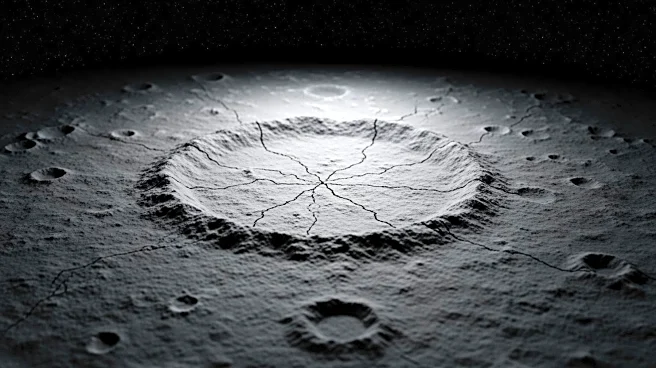
Recent research has revealed that a colossal asteroid impact may have significantly altered the moon's internal structure, leading to the distinct differences between its near and far sides. The study,
conducted by a team led by Heng-Ci Tian from the Chinese Academy of Sciences, analyzed samples from the moon's South Pole–Aitken Basin, brought back by China's Chang'e 6 mission. The findings indicate an unusual ratio of potassium isotopes, suggesting that the impact caused a loss of volatile elements, including potassium, due to the intense heat and pressure. This event is believed to have affected the moon's crust and mantle, contributing to the lack of volcanic plains, or maria, on the far side compared to the near side.
Why It's Important?
This discovery provides crucial insights into the moon's geological history and the effects of asteroid impacts on celestial bodies. Understanding these processes can help scientists better comprehend the formation and evolution of planetary surfaces, which is essential for future lunar exploration and potential colonization. The research also highlights the importance of isotopic analysis in revealing the conditions and consequences of such impacts, offering a window into the moon's past and its structural changes over billions of years.