
What's Happening?
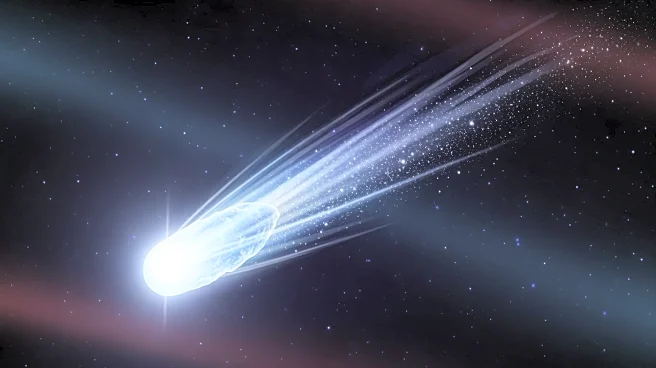
Comet 3I/ATLAS, the third interstellar object known to pass through our solar system, is accelerating as it approaches its closest point to Earth. Scientists have observed significant non-gravitational
accelerations in the comet, attributed to the release of gas as it nears the Sun. Despite its acceleration, the comet poses no threat to Earth, as it will pass no closer than 170 million miles. Discovered in July by NASA's ATLAS survey telescope, 3I/ATLAS is on a hyperbolic trajectory, indicating it is not bound by the Sun's gravity and is merely passing through the solar system. The comet's closest approach to Earth is projected for December 19.
Why It's Important?
The observation of 3I/ATLAS provides a rare opportunity to study an interstellar object, offering insights into the composition and behavior of celestial bodies from outside our solar system. The comet's acceleration and trajectory help refine our understanding of interstellar objects and their interactions with solar radiation. This event also serves as a valuable exercise for planetary defense systems, enhancing our ability to track and predict the paths of near-Earth objects. The data collected from 3I/ATLAS could inform future strategies for monitoring and potentially mitigating threats from space.