





What's Happening?
NASA's Starling mission, a swarm of four cubesats in low Earth orbit (LEO), has extended its GPS-free navigation experiment until at least 2028. The mission, which began three years ago, tests a technology called FALCON (Fast Autonomous Lost-in-space
Catalog-based Optical Navigation). FALCON enables satellites to navigate by using other satellites as moving landmarks, a crucial capability for missions operating beyond Earth's orbit where GPS signals are unavailable. The experiment involves using Starling's cameras to observe other satellites and space objects, matching this data with an onboard catalog of thousands of known objects, and then using these verified objects as reference points to determine Starling's orbit. This method also contributes to space situational awareness (SSA), allowing spacecraft to understand their surrounding environment and avoid debris. The extension aims to maximize the data and insights gained from this innovative navigation technique.
Why It's Important?
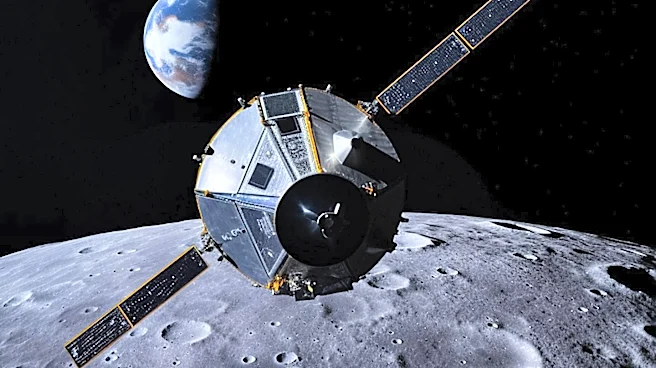
The extension of the Starling mission is critical for the future of U.S. space exploration and national security. As NASA plans for more missions beyond Earth's orbit, including sending astronauts to the Moon's surface by 2028 and establishing a lunar base, GPS-independent navigation becomes indispensable. Traditional GPS signals weaken significantly or are non-existent in cislunar space and beyond, making autonomous navigation solutions like FALCON vital for lunar satellite swarms, distributed science missions, and human exploration. Furthermore, the U.S. Department of Defense is also keenly interested in alternative positioning, navigation, and timing (PNT) capabilities due to concerns about the vulnerability of GPS satellites to adversaries. This technology not only enhances civilian space endeavors but also strengthens national security by providing resilient navigation solutions in contested or GPS-denied environments, ensuring the continuity and safety of critical space operations.
What's Next?
The Starling mission will continue its operations until at least 2028, focusing on further refining and validating the FALCON technology. The ongoing experiment will aim to enhance the accuracy and robustness of GPS-independent navigation, particularly in complex orbital environments. NASA officials anticipate that the results from FALCON will have far-reaching implications for on-orbit space-traffic monitoring, collision avoidance, and alternative navigation methods. The insights gained will be directly applied to future lunar missions, including the Artemis program, and potentially to other deep space exploration initiatives. The collaboration with industry partner EraDrive will likely continue, fostering further advancements in autonomous spacecraft navigation. The mission's success could also spur additional research and development in SSA, leading to more sophisticated systems for managing the increasingly crowded space environment.
Beyond the Headlines
The Starling mission's success in demonstrating GPS-free navigation represents a paradigm shift in how spacecraft can operate autonomously in vast and challenging environments. This capability reduces reliance on ground control and external signals, offering greater flexibility and resilience for missions. Ethically, it empowers spacecraft to make independent decisions regarding their trajectory and safety, which is crucial for long-duration missions where real-time human intervention is impractical. Culturally, it pushes the boundaries of human ingenuity, showcasing how complex problems in space can be solved through innovative technological solutions. The development of such autonomous systems also raises questions about the future role of human operators in space missions, potentially shifting towards oversight and strategic planning rather than constant real-time control. This advancement is a foundational step towards a future where space exploration is more self-sufficient and less constrained by Earth-based infrastructure.