
What's Happening?
NASA-supported scientists have unveiled new insights into how Earth may have acquired essential elements for life, highlighting Jupiter's influence in the process. The study, published in Science Advances,
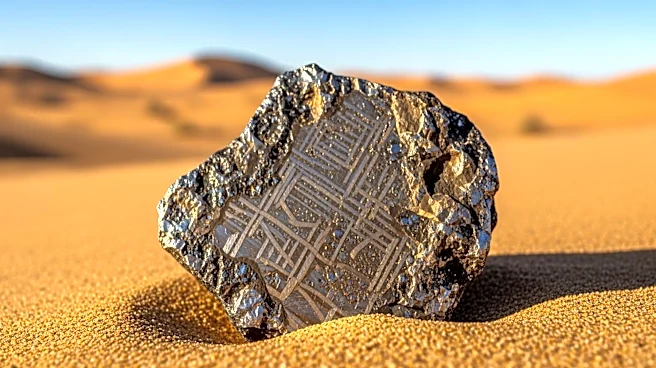
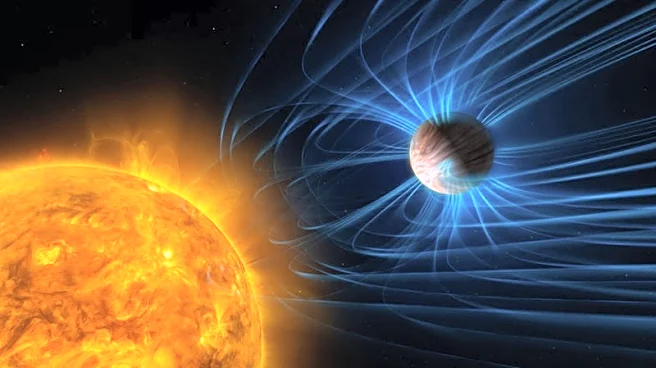
examines the phosphorus to nitrogen ratio in meteorites, suggesting that Earth obtained these elements primarily from the inner solar system. Jupiter's formation and gravitational influence played a crucial role in restricting the movement of these elements, leading to a higher phosphorus to nitrogen ratio in the inner solar system. This discovery challenges previous theories that outer solar system chondrites significantly contributed to Earth's elemental inventory.
Why It's Important?
This research provides a deeper understanding of the early solar system's dynamics and the formation of habitable planets. By identifying Jupiter's role in the distribution of life-essential elements, the study offers insights into planetary formation processes that could apply to other solar systems. This knowledge is crucial for astrobiologists studying the conditions necessary for life and could influence future explorations of exoplanets. Understanding the elemental composition of Earth also aids in comprehending the planet's geological and biological history.
What's Next?
Future research may focus on exploring the implications of these findings for other planetary systems, particularly those lacking a Jupiter-like planet. Scientists may also investigate the potential for similar elemental distributions in exoplanetary systems, which could inform the search for extraterrestrial life. Continued study of meteorites and planetary formation models will further refine our understanding of the solar system's history and the conditions that make planets habitable.