



What's Happening?
The James Webb Space Telescope (JWST) recently investigated two stars suspected of harboring Dyson spheres, a concept proposed by physicist Freeman Dyson in 1960, which suggests that advanced alien civilizations might build massive structures around stars to
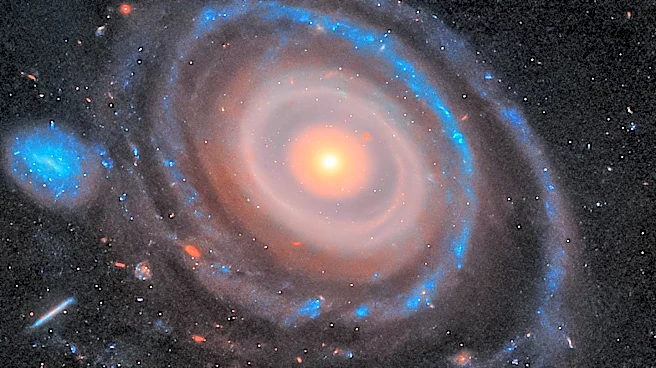
harness their energy. The JWST's observations revealed that the stars' light was being amplified by distant galaxies almost perfectly aligned behind them, creating an illusion of Dyson spheres. This finding underscores the importance of developing new techniques to differentiate between natural phenomena and potential technosignatures of alien civilizations.
Why It's Important?
This discovery is significant as it highlights the challenges in the search for extraterrestrial intelligence, emphasizing the need for advanced methods to distinguish between genuine technosignatures and natural cosmic phenomena. The research not only rules out two potential Dyson sphere candidates but also provides astronomers with valuable insights into the universe's ability to mimic such structures. The findings contribute to refining future searches for alien technology and enhance our understanding of cosmic alignments and their effects on astronomical observations.
What's Next?
The results from the JWST's observations pave the way for future studies using next-generation telescopes, which can utilize the closer stars as adaptive optics guides to observe the more distant galaxies. This approach will help astronomers better understand the universe's complexities and improve the accuracy of identifying potential technosignatures. The research also encourages the development of new techniques to untangle light and address the quirks of current telescopic technology, ensuring more reliable searches for extraterrestrial intelligence in the future.