






What's Happening?
Austin, Texas-based defense startup Vigil Autonomy, led by founder Matt Goodman, introduced 'Air Cover' in late October 2026. This autonomous flying camouflage system is designed to protect military vehicles, personnel, and equipment from thermal-infrared
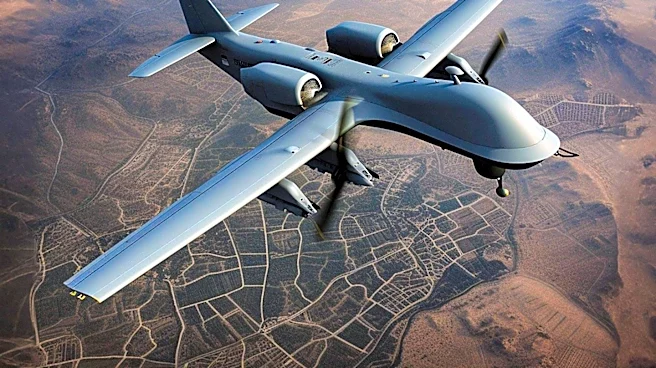
cameras and synthetic aperture radar (SAR) surveillance. The system uses four corner-mounted aerial lift units to deploy and reposition interchangeable multispectral camouflage membranes, covering areas up to 100 square meters. This innovation aims to eliminate the need for manual dismantling of conventional camouflage between vehicle relocations. Managed by proprietary ISR Control software, Air Cover can maintain concealment above equipment in 'Stealth Mode' or divert enemy reconnaissance drones using an 'airborne Decoy Mode.' The system addresses the increased vulnerability of military assets to modern reconnaissance technologies, particularly highlighted by recent conflicts. While the system offers significant operational advantages by automating camouflage deployment and repositioning, specific performance metrics such as maximum tracking speed, wind tolerance, deployment time, and measured reduction in radar and infrared signatures have not yet been disclosed by the manufacturer. As of November 4, 2026, no military procurement contract or independently validated operational evaluation has been confirmed.
Why It's Important?
The introduction of Air Cover by Vigil Autonomy represents a significant advancement in military concealment technology, directly addressing critical vulnerabilities exposed in modern warfare. The automation of camouflage deployment and repositioning can drastically reduce the exposure time of military personnel and equipment, which is crucial in environments dominated by advanced reconnaissance drones, thermal sensors, and radar surveillance. This technology could enhance the survivability of high-value assets like artillery batteries, command vehicles, and logistics trucks during transit, refueling, and temporary deployments. By offering both concealment and deception capabilities, Air Cover could complicate enemy targeting efforts, forcing adversaries to expend more resources on identification and tracking. The potential for interchangeable camouflage membranes also allows for adaptability to various operational environments and threat profiles. This innovation could influence future military doctrine regarding passive defense measures, emphasizing agility and rapid concealment in dynamic combat zones. The U.S. military, and its allies, stand to gain a tactical advantage by integrating such systems, potentially reducing casualties and equipment losses.
What's Next?
The immediate next steps for Vigil Autonomy will likely involve rigorous testing and validation of the Air Cover system's performance metrics. The manufacturer needs to disclose crucial data such as maximum tracking speed, wind tolerance, deployment time, and the measured reduction in radar and infrared signatures to attract military procurement. Independent operational evaluations will be essential to demonstrate the system's effectiveness in real-world scenarios. Potential reactions from military leaders will hinge on these validated performance figures and the system's cost-effectiveness compared to conventional methods. If successful, the technology could see pilot programs with U.S. military branches, particularly those involved in ground operations and logistics. Further development might focus on integrating the system with existing command and control networks and exploring its application across a wider range of military platforms. The open-interface architecture suggests potential for collaboration with other camouflage suppliers, which could lead to more versatile and effective solutions.
Beyond the Headlines
Beyond its immediate tactical benefits, Air Cover's autonomous nature raises broader implications for military operations and the future of warfare. The shift towards automated concealment systems could reduce the physical burden and risk on soldiers, allowing them to focus on other critical tasks. However, it also introduces new dependencies on technology, including battery life, software reliability, and resistance to electronic warfare. The 'Decoy Mode' highlights an evolving aspect of military deception, where artificial signatures are used to confuse and misdirect adversaries, potentially leading to a more complex and information-rich battlefield. Ethical considerations might arise regarding the use of autonomous systems in combat, particularly concerning their decision-making processes in dynamic environments. Long-term, this technology could accelerate the development of fully autonomous military support systems, further transforming the nature of ground combat and logistics. The emphasis on rapid, adaptable concealment also underscores a strategic shift towards more agile and distributed military operations, moving away from static, easily targetable positions.