


What's Happening?
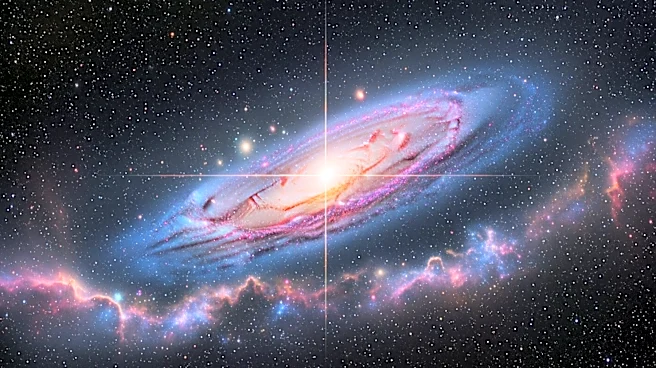
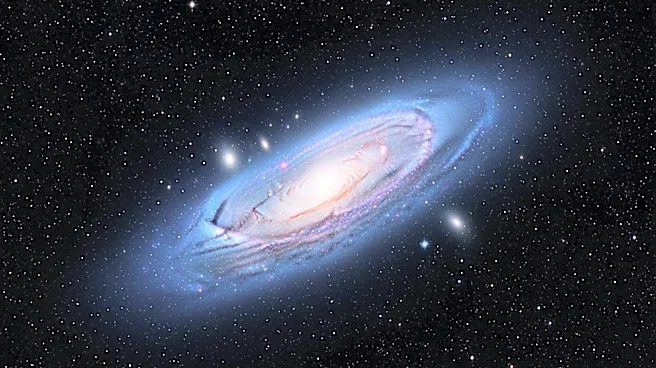
Astronomers using the James Webb Space Telescope (JWST) have identified a stellar bar in GN20, a massive galaxy that existed just 1.5 billion years after the Big Bang. This discovery challenges existing models that suggest bar formation should be delayed
in such early, gas-rich environments. The stellar bar, spanning seven kiloparsecs, is believed to drive intense star formation and possibly fuel a central black hole. The findings suggest that bar-driven processes may play a significant role in the rapid evolution of early galaxies, potentially explaining the emergence of massive, quiescent ellipticals.
Why It's Important?
The discovery of a stellar bar in GN20 is significant as it challenges the current understanding of galaxy formation and evolution. Traditionally, it was believed that the formation of stellar bars in gas-rich environments would be suppressed or delayed. However, the presence of a bar in GN20 suggests that these structures can form much earlier than previously thought, potentially influencing the development of galaxies in the early universe. This could lead to a reevaluation of models related to galaxy evolution and the role of bars in star formation and black hole growth.
What's Next?
Further observations and analyses are needed to confirm the findings and understand the implications of this discovery. Researchers may focus on obtaining more precise measurements of the stellar mass and core regions of GN20 to refine their models. Additionally, the study of other early galaxies with similar characteristics could provide more insights into the prevalence and impact of stellar bars in the early universe. This research could ultimately reshape the understanding of how galaxies evolve over time.