





What's Happening?
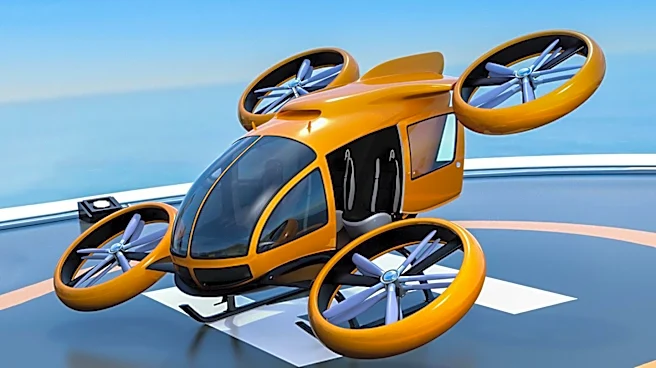
The Florida Polytechnic University Police Department has become the first U.S. law enforcement agency to acquire an electric vertical takeoff and landing (eVTOL) vehicle, specifically the single-seat Jetson One. The university is actively seeking approval
from the Federal Aviation Administration (FAA) to utilize this eVTOL for aerial patrols. This initiative aims to enable officers to access areas that are challenging to reach with traditional ground vehicles, potentially enhancing response capabilities and surveillance in difficult terrains or congested environments. The Jetson One is a recreational eVTOL designed for short flights, with a flight time of approximately 20 minutes and speeds up to 63 mph.
Why It's Important?
This move by the Florida Polytechnic University Police Department is a significant step in integrating advanced air mobility into public services within the U.S. If approved by the FAA, it could set a precedent for other law enforcement agencies nationwide to adopt eVTOL technology for various operational needs, including search and rescue, surveillance, and rapid response. This development highlights the potential for eVTOLs to serve critical public functions beyond their initially envisioned role as air taxis. It also underscores the ongoing evolution of regulatory frameworks as the FAA grapples with certifying and integrating new classes of aircraft into U.S. airspace, impacting public safety, operational efficiency, and the broader adoption of eVTOL technology.
What's Next?
The immediate next step involves the Florida Polytechnic University Police Department securing FAA approval for the operational use of the Jetson One eVTOL for patrols. This approval process will likely involve detailed assessments of safety protocols, pilot training, operational procedures, and airspace integration. The FAA's decision will be critical in shaping how eVTOLs are utilized by public service entities in the future. Should approval be granted, it could pave the way for other U.S. law enforcement and emergency services to explore similar applications, potentially leading to increased demand for recreational and utility-focused eVTOL models. The outcome will also inform future regulatory guidelines for eVTOL use in non-commercial, public sector roles.
Beyond the Headlines
The deployment of eVTOLs by law enforcement raises several deeper implications. Ethically, it brings questions about privacy and surveillance, as aerial patrols could offer new capabilities for monitoring public spaces. Legally, the FAA's regulatory framework for eVTOLs, particularly for public agency use, will need to evolve to address these novel applications, including considerations for pilot licensing, operational limitations, and accident liability. Culturally, the sight of 'flying cars' used by police could alter public perception of law enforcement and technology, potentially fostering both increased security and concerns about over-surveillance. This development also highlights the dual-use potential of emerging technologies, moving beyond consumer applications to critical public infrastructure and services.