





What's Happening?
A recent survey conducted by the Knight Foundation in partnership with Ipsos reveals a substantial decline in U.S. college students' perception of free speech security. Only 37% of college students believe free speech is secure today, a sharp drop from
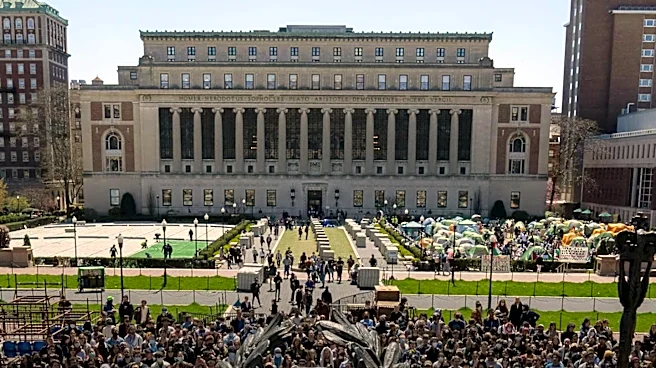
73% in 2016. This marks the lowest level observed since the survey began. The study, part of the 'Future of the First Amendment' research, also indicates a decrease in confidence regarding other First Amendment freedoms, such as the right to a free press, which only 40% of students now consider secure, down from 81% a decade ago. These findings emerge amidst ongoing debates on free expression and academic freedom on campuses, characterized by instances of students disrupting speakers, universities penalizing activists, and lawmakers influencing curriculum. While 57% of students reported feeling discouraged from speaking their minds on campus this year, this is an improvement from 65% in 2021. Despite these concerns, 84% of college students still consider free speech to be extremely or very important.
Why It's Important?
This decline in perceived free speech security among U.S. college students has significant implications for the future of democratic discourse and academic environments. A generation that feels their fundamental rights are threatened may be less likely to engage in open debate, critical thinking, and the challenging of ideas, which are cornerstones of higher education and a healthy democracy. The shift in attitudes also reflects a growing tension between the desire for free expression and the demand for protection from potentially offensive speech, with 28% of students now advocating for colleges to prohibit such speech, up from 18% in 2017. This trend could lead to increased self-censorship, a chilling effect on controversial topics, and a more polarized campus climate. The varying perceptions of free speech security based on political affiliation and race further highlight existing societal divisions, suggesting that efforts to foster inclusive and open dialogue must address these underlying disparities. The findings underscore the urgent need for universities to re-evaluate their approaches to free expression and civil discourse.
What's Next?
Universities are likely to continue grappling with how to balance free speech principles with the desire to create inclusive and safe environments for all students. The survey data provides a national baseline for understanding student sentiments, which can inform the development of civil discourse programs on college campuses. Administrators may focus on implementing interventions designed to encourage robust dialogue and debate, while also addressing concerns about offensive speech. This could involve clearer policies on campus protests, speaker invitations, and the use of language in academic settings. There may also be increased efforts to educate students on the historical context and importance of the First Amendment, as well as the responsibilities that accompany free expression. The ongoing political and social climate will likely continue to influence these discussions, with potential reactions from political leaders, civil society groups, and student organizations shaping the future of free speech on U.S. campuses.
Beyond the Headlines
The erosion of confidence in free speech among college students points to deeper societal shifts regarding tolerance, intellectual humility, and the nature of truth. The increasing demand for protection from offensive speech, even at the expense of open discourse, suggests a potential redefinition of the boundaries of acceptable expression. This trend could lead to a more fragmented public sphere, where individuals are less exposed to diverse viewpoints and more entrenched in their own echo chambers. Ethically, it raises questions about the role of educational institutions in preparing students for a complex world that requires engaging with challenging ideas. Legally, it may prompt further scrutiny of the First Amendment's application in digital spaces and on private platforms. Culturally, it reflects a broader struggle to reconcile individual liberties with collective well-being, potentially leading to long-term changes in how society values and practices free expression.