




What's Happening?
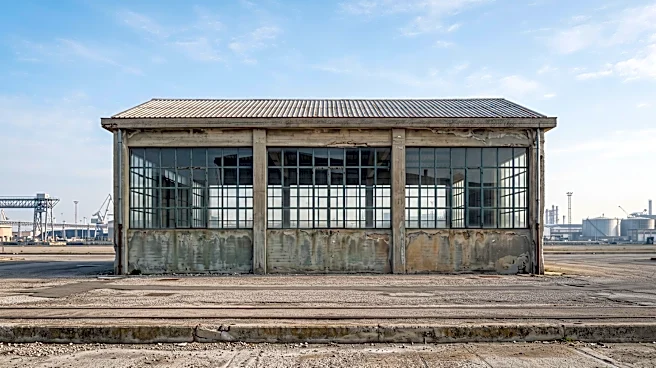
In Porto Marghera, Venice's port district, a single-story industrial building known as the Capannone has become a focal point of contention regarding the heritage of deindustrialization. Originally built in the early 1970s to host worker assemblies, the Capannone has evolved
into an 'anti-museum' filled with art and artifacts created by artist-activists and worker-artists. These works document the history of deindustrialization in the area, from early protests against 'capitalist restructuring' in the 1970s to the closure of the nylon plant in 2003 and the petrochemical complex in 2022. The collection includes paintings, banners, and sculptures, many of which were used in demonstrations against industrial crises and job cuts. The Capannone has served as a significant gathering place for workers, hosting assemblies, funerals, concerts, and plays, and has seen visits from national political figures.
Why It's Important?
The dispute over the Capannone highlights a broader struggle in post-industrial communities: how to preserve and interpret the legacy of deindustrialization without turning it into a mere relic. The workers and unions involved in the Capannone's history are resisting attempts by the City of Venice to transform it into a cultural venue or a traditional museum. They argue that the art and artifacts within the Capannone represent an ongoing narrative of working-class struggle and identity, not a finished history to be curated by external institutions. This resistance underscores the importance of community self-determination in shaping historical narratives and preventing the commodification of their past. The outcome of this contest could set a precedent for how other deindustrialized regions approach their heritage, emphasizing lived experience and ongoing relevance over conventional museumification.
What's Next?
Following the closure of the last part of the petrochemical complex in 2022, the company sold the Capannone to the City of Venice. The city's proposal to convert it into a cultural events venue was met with a month-long occupation by shop stewards and union activists, who were not consulted and opposed the idea of it becoming a 'lieu de mémoire' or a traditional museum. Although the municipal government has since backtracked, an agreement on the future use of the space has yet to be signed. The unions insist that the Capannone's art collection should remain open and belong to the workers, without requiring tickets for entry. The ongoing negotiations will determine whether the Capannone maintains its identity as a living testament to worker power and history or transitions into a more conventional cultural space.
Beyond the Headlines
The struggle over the Capannone delves into profound questions about who controls historical narratives and the ethical implications of heritage initiatives in communities with complex relationships to their industrial past. The workers' insistence on self-management and their rejection of a 'museum with no curators and no plan' challenges traditional notions of heritage preservation. It highlights the potential for 'anti-museums' or community-led spaces to offer more authentic and dynamic interpretations of history, particularly for marginalized groups. This case also brings to light the tension between economic development through cultural tourism and the preservation of local identity and memory. The Capannone's story is a powerful reminder that heritage is not always a universally agreed-upon concept but often a site of ongoing contestation and negotiation, reflecting deeper societal values and power dynamics.