



What's Happening?
A federal judge has issued a preliminary injunction, temporarily preventing Virginia from enforcing key provisions of a new state law that sought to restrict cooperation between local law enforcement and federal immigration authorities. Senior U.S. District
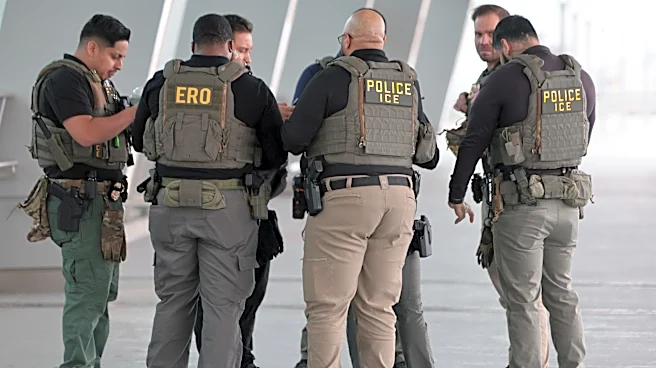
Court Judge Robert Payne in Richmond ruled on Monday to bar the commonwealth from applying the law against federal immigration officers, employees, or agencies, and from interfering with existing agreements under Section 287(g) of federal immigration law. These agreements permit U.S. Immigration and Customs Enforcement (ICE) to authorize trained state and local officers to perform certain federal immigration enforcement duties. Virginia's new law, which became effective July 1, required existing 287(g) agreements to be rewritten by September 1 to include a dozen new conditions, or else they would be considered void. Judge Payne's order allows these existing partnerships to continue while the legal challenge proceeds. However, one restriction remains in place: localities and law enforcement agencies that have not previously participated in the 287(g) program are still prohibited from entering such agreements for the first time.
Why It's Important?
This ruling is significant as it upholds the federal government's authority in immigration enforcement and impacts the operational capabilities of ICE within Virginia. The federal government argued that Virginia's law unconstitutionally interferes with federal immigration enforcement and impairs existing contracts between ICE and Virginia localities. Judge Payne found that the federal government was likely to succeed on its claims that the law violates the U.S. Constitution’s Contract Clause and Supremacy Clause. The decision suggests that the new requirements created a 'substantial impairment' of existing agreements and were not appropriately tailored to advance a legitimate public purpose, and that the Virginia law directly regulates federal law enforcement in an area under federal authority. This outcome means that federal immigration authorities can continue their existing enforcement activities with local cooperation, which has seen an acceleration in Virginia and Maryland, with 1,328 arrests reported in a two-week period. The ruling also highlights the ongoing tension between state and federal powers regarding immigration policy and enforcement.
What's Next?
Virginia Attorney General Jay Jones has stated his office will immediately seek to keep the injunction from taking effect and will appeal the court’s decision. Jones argues that the ruling misinterprets contract law and the state’s authority over its local governments, asserting that the conditions apply to Virginia’s localities, not directly to ICE. The injunction will remain in place as the case proceeds, or until further court orders. The U.S. Justice Department, which sued Virginia in June, will continue to argue its case that the state law is unconstitutional. Federal labor unions and immigrant rights groups are closely watching the developments, with the Virginia Coalition for Immigrant Rights expressing disappointment and the Legal Aid Justice Center urging the state to appeal. The final resolution of this legal dispute will determine the long-term framework for cooperation between state and local law enforcement and federal immigration authorities in Virginia.
Beyond the Headlines
This legal battle delves into fundamental questions of federalism and the division of powers between state and federal governments, particularly in areas of shared jurisdiction like law enforcement and immigration. The ruling underscores the U.S. Constitution's Contract Clause and Supremacy Clause as critical legal tools in defining these boundaries. Beyond the immediate operational impact on ICE, the case reflects broader societal debates about immigration policy, local control, and civil liberties. The Legal Aid Justice Center's concern that existing 287(g) agreements 'undermine the trust communities need to report crimes and cooperate with investigations' points to the social and ethical dimensions of local law enforcement involvement in federal immigration matters. The outcome could set precedents for other states attempting to regulate or limit cooperation with federal immigration agencies, influencing the national landscape of immigration enforcement and community relations.