









What's Happening?
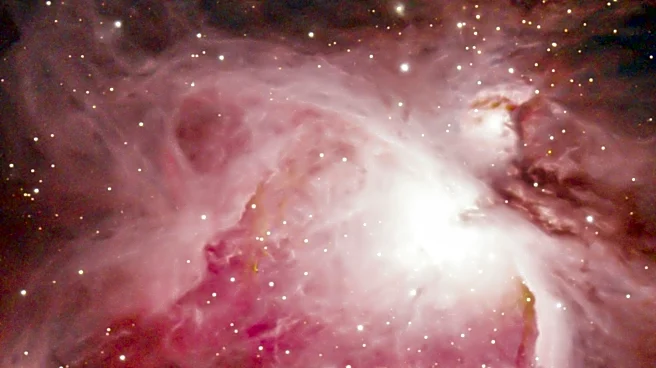
An international team of astronomers, led by Juan Diego Soler from the University of Vienna, has utilized two of the world's most powerful radio telescopes to reveal previously hidden structures within the Orion Nebula. This effort has resulted in the most detailed
maps of neutral hydrogen in this star-forming region. The study, which involved the Karl G. Jansky Very Large Array in the United States and the 500-meter-aperture Spherical Radio Telescope in China, uncovered giant expanding shells, voids, and elongated structures that were previously undetected. These findings suggest that the Orion Nebula formed through multiple episodes of stellar feedback rather than a single expanding bubble. The research challenges existing theories about star formation and highlights the capabilities of modern radio telescopes in advancing our understanding of the universe.
Why It's Important?
The discovery of these hidden structures in the Orion Nebula is significant as it challenges current models of star formation. By revealing the complex interactions between star-forming regions and their surroundings, the study provides new insights into how massive stars influence their environment. This research not only enhances our understanding of the Orion Nebula but also serves as a reference for astrophysical simulations of gas and star evolution in the Milky Way. The findings underscore the importance of advanced radio telescopes in uncovering the intricacies of the interstellar medium, which could lead to revisions in theoretical models and simulations used by astronomers worldwide.
What's Next?
The research team suggests that the methods developed for this study could be applied to other regions of the interstellar medium, potentially revealing hidden structures and dynamics in areas previously thought to be well understood. Future interferometers are expected to further illuminate the complexities of star formation processes. As astronomers continue to explore the universe with these advanced tools, they anticipate uncovering more about the hidden dynamics of star-forming regions, which could lead to significant advancements in the field of astrophysics.