



What's Happening?
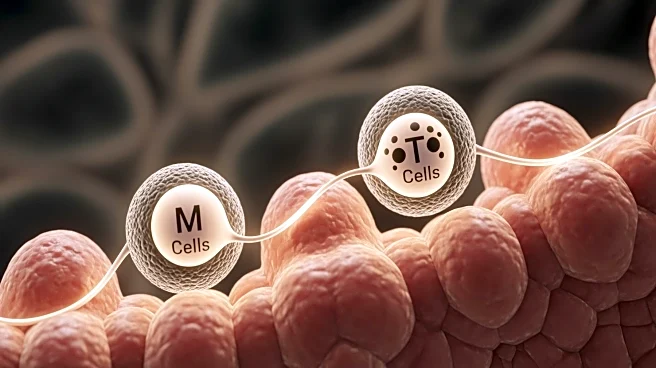
A recent study published in the journal Nature has uncovered new insights into the role of microfold (M) cells in the human gut, particularly in their function as antigen-presenting cells. These cells, which resemble dendritic cells, are involved in processing
and presenting gluten peptides through a pathway similar to that of dendritic cells. This discovery is significant in understanding the early immune responses in celiac disease. The study highlights that M cells express the class II major histocompatibility complex (MHC-II) independently of inflammatory cues, a feature that distinguishes them from other intestinal cells. Researchers developed an intestinal organoid model to study the differentiation and function of human M cells, revealing their potential role in presenting gluten antigens to T cells, a process crucial in the pathogenesis of celiac disease.
Why It's Important?
The findings of this study have significant implications for understanding the immune mechanisms underlying celiac disease, an autoimmune disorder triggered by gluten. By identifying M cells as key players in antigen presentation, the research provides a potential target for therapeutic interventions aimed at modulating immune responses in celiac disease. This could lead to the development of new treatments that specifically target the antigen presentation process, potentially reducing the immune system's attack on gluten and alleviating symptoms in patients. Furthermore, the study enhances the understanding of gut immunity and the unique role of M cells, which could have broader implications for other autoimmune and inflammatory diseases.
What's Next?
Future research is likely to focus on further elucidating the role of M cells in vivo within the complex lymphoid microenvironment of the intestine. Understanding the full contribution of these cells to antigen presentation and immune modulation could pave the way for novel therapeutic strategies. Additionally, exploring the potential for manipulating M cell function to prevent or treat celiac disease and other related disorders will be a key area of interest. Researchers may also investigate the possibility of using M cells as a model for studying other antigen presentation processes in the gut.
Beyond the Headlines
The study's findings suggest that M cells could serve as a model for understanding antigen presentation in other contexts, potentially offering insights into the development of vaccines or treatments for various immune-related conditions. The unique ability of M cells to present antigens without inflammatory cues highlights their potential role in maintaining immune homeostasis in the gut, which could have implications for understanding the balance between immune tolerance and activation in the gastrointestinal tract.