


What's Happening?
Dr. Laila Nehmé, a French archaeologist and research fellow with the French National Centre for Scientific Research, has been actively involved in archaeological projects in AlUla, Saudi Arabia, since 2002. Her primary focus is on the Nabataean civilization,
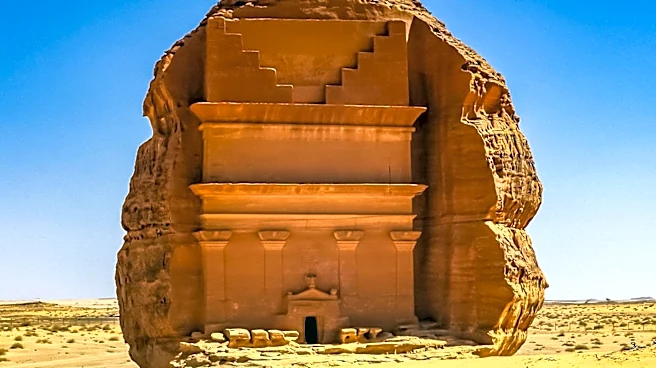
an ancient Arab people. Nehmé has conducted extensive research and excavations at Hegra, also known as Madain Salih or Al-Hijir, a significant Nabataean site. Her work has involved documenting inscriptions and rock art found on AlUla's sandstone cliffs, which span from prehistoric times to the Nabataean era. These discoveries provide insights into the political systems, economies, and technological advancements of past societies that inhabited or passed through the region over thousands of years. Nehmé's research also includes the study of ancient languages like Greek, Aramaic, and Nabataean Aramaic, which were used in inscriptions found in the area. She has also led desert expeditions to trace ancient caravan routes, including one between Hegra and Tayma.
Why It's Important?
Dr. Nehmé's decades of archaeological work in AlUla are crucial for understanding the rich and diverse heritage of the region. Her meticulous documentation and research contribute significantly to the global understanding of ancient civilizations, particularly the Nabataeans. The discoveries, such as remarkably well-preserved skeletons and textile fragments, offer unique insights into the daily lives, burial practices, and trade connections of these ancient peoples. For instance, the analysis of a small silk fragment found in a monumental tomb at Hegra indicated that the Incense Route and the Silk Road intersected at AlUla, highlighting the region's historical importance as a crossroads of ancient trade. This research not only enriches academic knowledge but also supports the development of AlUla as a cultural and tourism hub, allowing a broader audience to connect with its profound history. The detailed scientific analysis of artifacts helps reconstruct historical narratives that would otherwise be lost.
What's Next?
Dr. Nehmé's work continues to contribute to the ongoing efforts to preserve and present AlUla's historical significance. Her book, 'Guide to Hegra: Archeology in the Land of Nabataeans of Arabia,' serves as a comprehensive resource for researchers and enthusiasts. Additionally, her co-curation of the 'AlUla: Wonder of Arabia' exhibition in Paris and Beijing indicates a continued effort to share these archaeological findings with an international audience. Future endeavors will likely involve further excavations, detailed analyses of newly discovered artifacts, and the continued exploration of ancient caravan routes. The ongoing collaboration between French and Saudi institutions suggests a sustained commitment to archaeological research and heritage preservation in the region, potentially leading to more exhibitions, publications, and educational initiatives that highlight AlUla's unique historical narrative.
Beyond the Headlines
The archaeological work in AlUla, exemplified by Dr. Nehmé's contributions, transcends mere historical discovery; it underscores the ethical imperative of rigorous documentation and preservation in archaeology. The understanding that excavated layers are lost forever emphasizes the critical need for systematic recording, ensuring that future generations can access and interpret these findings. This approach highlights the delicate balance between uncovering the past and safeguarding its integrity. Furthermore, the interdisciplinary nature of the research, involving textile specialists, chemists, and proteomic analysts, demonstrates how modern scientific techniques are revolutionizing archaeology, allowing for deeper insights from seemingly insignificant fragments. The effort to connect heritage research with public engagement, as seen in exhibitions and books, also reflects a broader trend in archaeology to make historical knowledge accessible and relevant to contemporary society, fostering cultural appreciation and understanding.