
What's Happening?
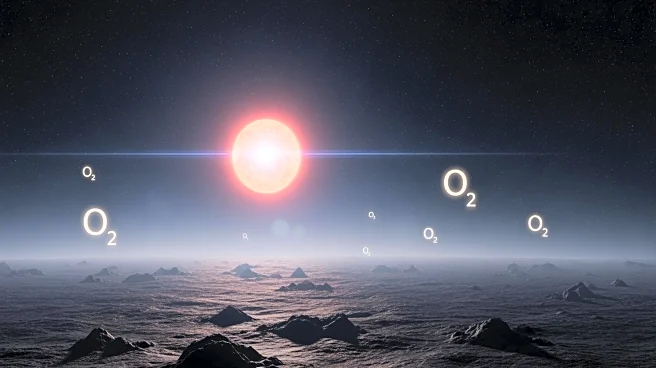
A recent study suggests that late M-stars, despite being abundant and capable of hosting Earth-like planets, are unlikely to support the emergence of complex animal life. This conclusion is based on the mismatch
between the light emitted by these stars and the light required for oxygenic photosynthesis, a critical process for atmospheric oxygen accumulation. The study, presented by astronomers Bill Welsh and Joseph Soliz, indicates that the timescales required for key biological events, such as the Great Oxidation Event and the Cambrian Explosion, would far exceed the expected lifespan of planets orbiting late M-stars. Consequently, ecosystems on such planets would likely be dominated by organisms utilizing non-oxygenic photosynthesis, precluding the widespread oxygen accumulation necessary for complex animal metabolisms.
Why It's Important?
The findings of this study have significant implications for the search for extraterrestrial life. Late M-stars make up about 35% of all stars in the galaxy and are among the most detectable for Earth-like planets. However, the study suggests that these stars are biological dead ends for complex life due to their inability to support oxygenic photosynthesis. This revelation narrows the scope of potential habitable zones in the galaxy and challenges the assumption that Earth-like planets around these stars could harbor life similar to that on Earth. The study emphasizes the need to reconsider the criteria for habitability in the search for extraterrestrial life.
What's Next?
The study's findings may prompt a shift in focus for astronomers and astrobiologists, who may need to prioritize other types of stars in the search for complex life. Future research could explore alternative biosignatures and life-supporting conditions that do not rely on oxygenic photosynthesis. Additionally, the study may influence the design and objectives of upcoming space missions aimed at detecting life beyond Earth, as scientists seek to refine their understanding of what constitutes a habitable environment.