



What's Happening?
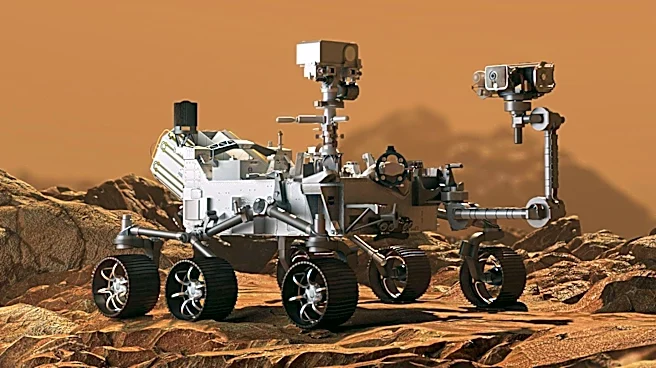
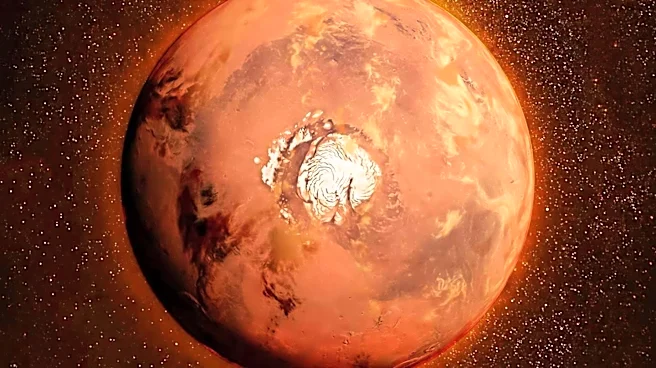
NASA's Perseverance rover has provided new data indicating that ultrafine Martian dust adheres stubbornly to spacesuit materials, posing a significant challenge for future crewed missions to Mars. Over 1,645 Martian days, the rover's PIXL instrument observed
that while larger dust particles dislodged from spacesuit fabric samples, particles as small as 100 nanometers remained attached. This is a critical finding as previous missions could only detect dust down to about 3 micrometers. The study, published in the Proceedings of the National Academy of Sciences, highlights that these tiny particles can penetrate seals, damage fabric, and, if inhaled, reach deep into human lungs. The dust's chemical composition, rich in sulfur, chlorine, iron, and perchlorates, further exacerbates health concerns due to potential thyroid disruption and cellular damage. Static electricity is believed to be the primary mechanism causing this persistent adherence.
Why It's Important?
This discovery has profound implications for the design and safety protocols of future U.S. crewed missions to Mars, including NASA's Artemis program. The persistent and chemically active nature of Martian dust necessitates advanced countermeasures to protect astronauts and their equipment. Engineers must now develop spacesuits and habitats capable of resisting these ultrafine particles, which are comparable in size to wildfire smoke and vehicle exhaust on Earth, known to cause heart and lung diseases. The findings underscore the need for robust dust mitigation strategies, such as improved airlocks, suitports that keep suits outside habitats, and electrostatic cleaning tools. Failure to adequately address this issue could lead to significant health risks for astronauts and compromise mission objectives, potentially increasing costs and delaying timelines for Mars exploration.
What's Next?
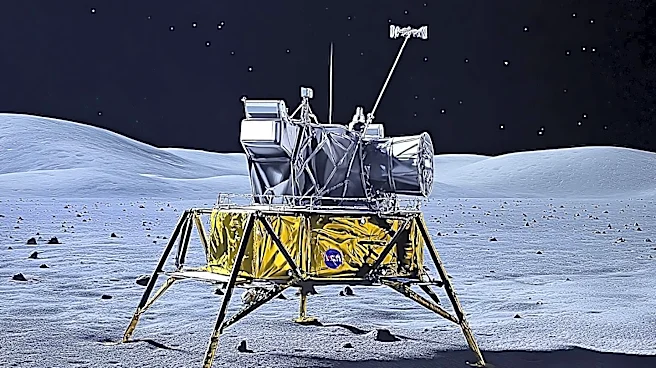
NASA is actively pursuing solutions to mitigate the Martian dust threat. Countermeasures are already being tested for Artemis Moon missions, including an Electrodynamic Dust Shield tested on Firefly's Blue Ghost lander in 2025, and Johnson Space Center is evaluating suit components and a handheld electrostatic dust tool. The Mars results suggest similar static-based cleaning methods will be crucial for Martian missions. NASA's Office of the Chief Health and Medical Officer has also drafted proposed limits for Martian dust inside crew habitats, aiming to keep particles smaller than 10 micrometers below a 24-hour average of 0.1 milligram per cubic meter for missions up to 30 days. The new data from Perseverance will help refine these standards and inform the development of next-generation spacesuits and habitat designs. Future analyses of other spacesuit material swatches on Perseverance will further inform which materials offer the best resistance.
Beyond the Headlines
The challenge posed by Martian dust extends beyond immediate health and equipment concerns, touching upon the long-term sustainability of human presence on Mars. The experience with lunar dust during the Apollo missions, which caused equipment damage and astronaut health issues, serves as a historical precedent. While Martian dust is less abrasive than lunar dust due to wind erosion, its clinging nature and chemical reactivity present a unique set of problems. This situation highlights the complex interplay between planetary environments and human technology, emphasizing that successful space exploration requires not only advanced engineering but also a deep understanding of extraterrestrial hazards. The development of effective dust mitigation technologies could also have terrestrial applications, particularly in industries dealing with hazardous fine particulate matter, fostering innovation beyond space exploration.