





What's Happening?
An international research team, including scientists from Syracuse University and led by Göttingen University in Germany, has published new findings in Nature Geoscience regarding the thermal evolution of Earth's subduction zones. The study analyzed a rare
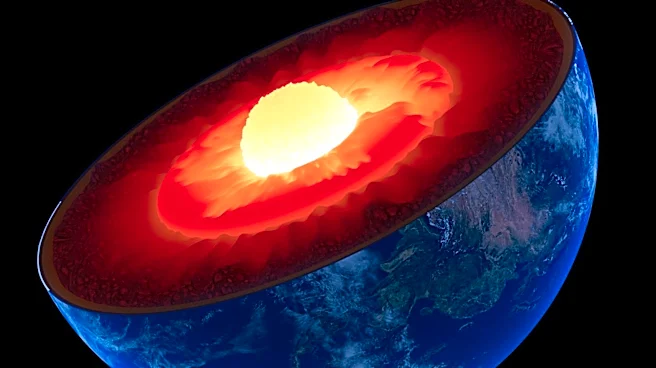
ultrahigh-pressure 'eclogite' rock sample collected over two decades ago by Syracuse University scientists in Papua New Guinea. This rock formed under extreme conditions deep within subduction zones, where one tectonic plate slides beneath another. By employing advanced analytical techniques, researchers reconstructed the rock's journey from the Earth's surface to depths exceeding 90 kilometers (56 miles) and its subsequent return. The surprising discovery was that the rock experienced warmer-than-anticipated conditions during its initial descent before transitioning to cooler conditions, despite reaching temperatures of about 800°C (1,470°F) at its deepest point. This suggests a more complex thermal evolution of subduction zones than previously understood.
Why It's Important?
This research is crucial for enhancing our understanding of fundamental geological processes that shape our planet. Subduction zones are responsible for many of the world's largest earthquakes and volcanic eruptions, and they play a significant role in regulating Earth's long-term climate by recycling carbon and other materials into the mantle. Accurate models of Earth's interior depend on precise knowledge of how rocks move through these systems and the temperatures they encounter. The new findings challenge existing models by revealing a more dynamic thermal history within subduction zones. This improved understanding can lead to better predictions of geological hazards, a more comprehensive grasp of Earth's carbon cycle, and insights into how mountain building and volcanism occur. The long-term investment in collecting and re-examining samples with new technologies highlights the value of sustained scientific inquiry and international collaboration in advancing Earth sciences.
What's Next?
The findings suggest several avenues for future research. Geologists will likely investigate whether rocks are heated more intensely at shallow depths due to shearing along tectonic plate boundaries, or if subduction zones may not cool as rapidly as current models predict, or a combination of both. The methodology used in this study, which reconstructs the complete pressure-temperature-time path of rocks, can be applied to other ultrahigh-pressure rocks globally. This multidisciplinary approach, involving international teams, will be essential for further discoveries. Continued refinement of analytical tools will allow scientists to extract even more detailed histories from geological samples, potentially revealing further secrets about the forces that shape the planet. This ongoing research will contribute to more accurate models of Earth's interior and its dynamic processes.
Beyond the Headlines
Beyond the immediate geological implications, this study underscores the enduring value of long-term scientific expeditions and the continuous evolution of scientific tools. A rock sample collected over two decades ago, initially analyzed with available technology, has now yielded groundbreaking insights thanks to new advancements. This demonstrates that scientific discoveries are not always immediate but can unfold over many years, with past data gaining new relevance through future technological innovations. It also highlights the importance of international collaboration in tackling complex scientific questions that transcend national boundaries. The ability to reconstruct such detailed geological histories from microscopic mineral inclusions speaks to the incredible power of modern scientific techniques to unlock the planet's deep past, offering a window into processes that have been shaping Earth for millions of years.