



What's Happening?
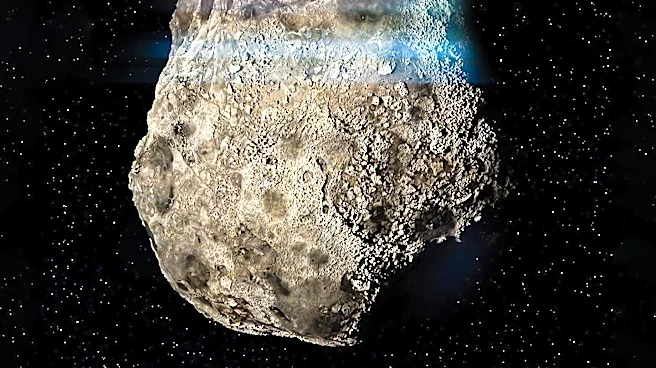
Astronomers have captured images of asteroid (44) Nysa, revealing it as the first-known 'trilobate' or three-headed asteroid in our solar system. Located in the main asteroid belt between Mars and Jupiter, Nysa was first observed in 1857, but its unique
structure was only recently resolved using the Very Large Telescope and the Large Binocular Telescope. The asteroid, approximately 47 miles in circumference, also has a small moon, S/2026 (44) 1, orbiting it.
Why It's Important?
The discovery of Nysa's unique shape provides valuable insights into the formation and evolution of asteroids, which are considered remnants from the early solar system. Understanding such structures can help scientists learn more about the conditions and processes that led to the formation of planets. The presence of a moon further adds to the complexity of this system, offering a rare opportunity to study gravitational interactions in small celestial bodies.