



What's Happening?
The mission to save NASA's Swift Observatory has been called off, leading to the telescope's inevitable fiery reentry into Earth's atmosphere later this year. NASA and Katalyst Space Technologies announced the failure over a month after Katalyst's Link
spacecraft launched to rescue the Swift telescope. Katalyst confirmed that the Link spacecraft will not attempt to capture Swift and boost it to a higher orbit due to persistent control issues. This means the Swift telescope, which has been tracking cosmic explosions like gamma-ray bursts and exploding stars for over 20 years, is now doomed. NASA had paid $30 million to Katalyst for this attempt to raise the telescope's orbit, as intense solar activity had caused it to lose altitude faster than anticipated. The rescue spacecraft experienced an uncontrollable spin shortly after its early July liftoff, and despite efforts to stabilize it, problems with pointing and positioning continued.
Why It's Important?
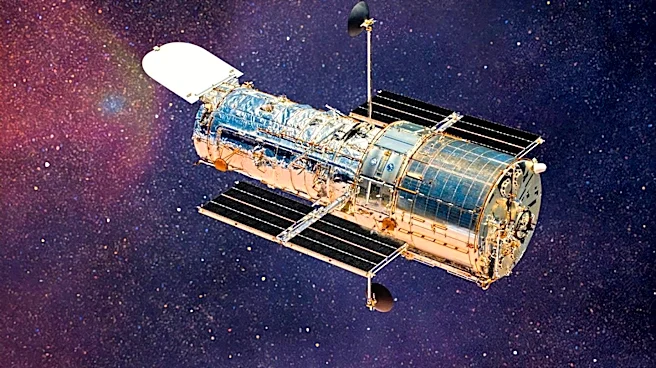
The failure of the Swift Observatory rescue mission represents a significant loss for astrophysics and space observation. Swift has been instrumental for over two decades in detecting and studying gamma-ray bursts, which are the most powerful explosions in the universe. Its unique capabilities in pinpointing these events will be difficult to replace immediately. This incident also highlights the increasing challenges of maintaining aging space infrastructure, especially in the face of unpredictable solar activity that can accelerate orbital decay. The $30 million investment in the rescue attempt underscores the scientific value placed on such missions, and its failure could lead to a reevaluation of future space debris mitigation and satellite life extension strategies. The outcome also has implications for other aging telescopes, such as the Hubble Space Telescope, which was next in line for a potential rescue if the Swift mission had succeeded.
What's Next?
The Swift Observatory is expected to continue its descent, with predictions indicating it will reach an altitude of 186 miles by October. Its re-entry into Earth's atmosphere is anticipated later this year, where it will burn up. While the primary rescue mission failed, Katalyst Space Technologies plans to continue operating the Link spacecraft in proximity to the Swift telescope. This continued operation will serve as a demonstration of capabilities for future rescue operations, allowing Katalyst to gather valuable data and experience despite the current setback. The fate of the Hubble Space Telescope, which is also experiencing orbital decay and was considered for a similar rescue, remains uncertain following this mission's failure. NASA will likely need to assess new strategies for extending the life of its valuable space assets and managing the growing issue of orbital debris.
Beyond the Headlines
This event underscores the complex and high-stakes nature of space operations, where even well-funded and technologically advanced missions can face unforeseen challenges. The failure of the Swift rescue mission could prompt broader discussions within the space community regarding the sustainability of long-duration missions and the development of more robust in-orbit servicing capabilities. It also brings to light the ethical considerations of space debris, as uncontrolled re-entries, while largely safe, carry a minimal risk. The scientific community will need to adapt to the loss of Swift's unique observational data, potentially accelerating the development of next-generation instruments or re-prioritizing existing ones. Furthermore, the incident serves as a stark reminder of the harsh environment of space and the constant battle against orbital mechanics and solar influences that impact satellite longevity.