








What's Happening?
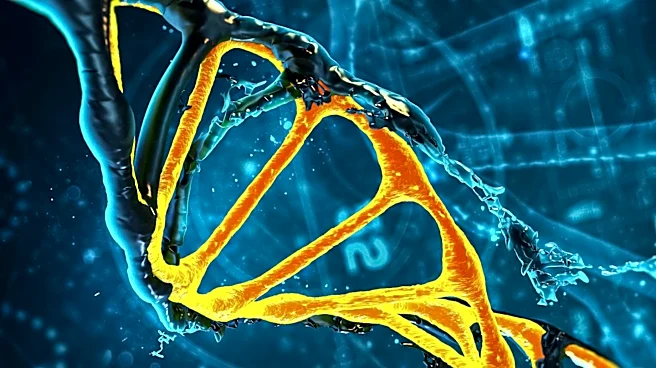
A recent study published in Science highlights the use of artificial intelligence (AI) to design synthetic RNA-guided nucleases that match or exceed the activity of natural enzymes. The research, conducted by scientists from the Innovative Genomics Institute
and the California Institute for Quantitative Bioscience at the University of California, Berkeley, demonstrates AI's potential to expand the CRISPR toolbox. The study focused on creating non-natural RNA-guided nucleases, which are challenging to design due to the complexity of multi-domain proteins. The AI-designed proteins, named SynTnpBs, were tested in bacterial, plant, and human cells, showing that many retained or surpassed the activity of natural TnpB enzymes. The study utilized cryo-electron microscopy to analyze the structures of the most divergent variants, revealing new electrostatic and hydrogen-bonding networks that stabilize interactions at the RNA-DNA interface.
Why It's Important?
The development of AI-designed synthetic nucleases represents a significant advancement in genetic engineering and biotechnology. By expanding the CRISPR toolbox, this research could lead to more precise and efficient gene editing techniques, potentially revolutionizing fields such as medicine, agriculture, and bioengineering. The ability to design proteins with novel properties beyond those found in nature could enable scientists to tackle complex biological challenges, such as developing new therapies for genetic disorders or creating crops with enhanced traits. This innovation underscores the transformative potential of AI in scientific research and its capacity to accelerate discoveries that were previously unattainable with traditional methods.