

What's Happening?
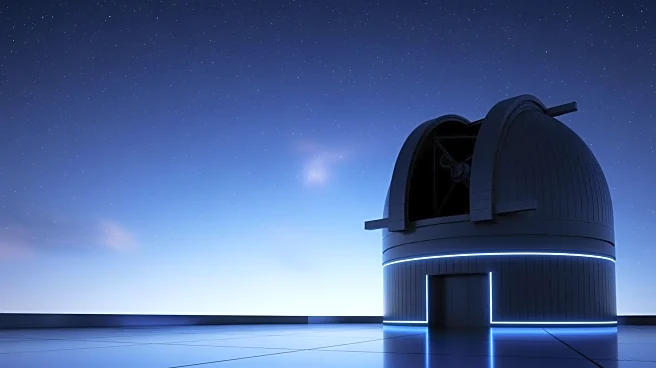
The Vera C. Rubin Observatory, located in Chile, has initiated a new information pipeline that allows for real-time monitoring of the southern sky. This development, which began on February 24, enables astronomers worldwide to receive alerts about cosmic
events such as new asteroids and supernovae within two minutes of detection. The observatory's Simonyi Survey Telescope is responsible for these discoveries, and the alerts are part of the observatory's Alert Production Pipeline, developed by the University of Washington. This system is expected to produce up to seven million alerts per night, significantly enhancing the ability to identify rare astronomical phenomena. The observatory is preparing to launch its Legacy Survey of Space and Time (LSST), a 10-year project that will use the largest digital camera ever built to capture changes in the Southern Hemisphere sky.
Why It's Important?
The real-time alert system of the Vera C. Rubin Observatory represents a significant advancement in astronomical research, allowing scientists to quickly respond to and study transient cosmic events. This capability is crucial for understanding phenomena such as supernovae and potentially hazardous asteroids. The observatory's ability to process and distribute vast amounts of data rapidly will likely lead to new discoveries and insights into the universe. The project underscores the importance of sustained federal support for scientific research, as highlighted by Kathy Turner from the U.S. Department of Energy. The observatory's work is expected to expand access to astrophysical data, benefiting researchers, students, and citizen scientists alike.
What's Next?
As the Vera C. Rubin Observatory prepares to launch the LSST, it will continue to refine its alert system and data processing capabilities. The observatory's work will likely lead to collaborations with other research institutions and contribute to a deeper understanding of the universe. The LSST's findings could influence future astronomical research priorities and funding decisions. Additionally, the public nature of the alerts may inspire increased public interest and engagement in astronomy.