
What's Happening?
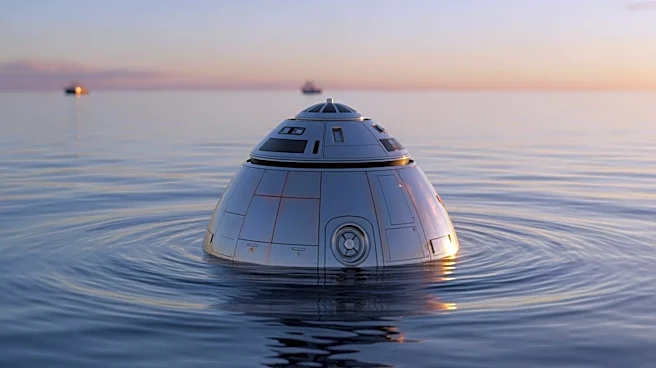
The Orion capsule, part of NASA's Artemis II mission, successfully reentered Earth's atmosphere, triggering a planned communication blackout period. This event marks a significant milestone in the mission, as
the capsule's reentry is a critical phase in testing the spacecraft's heat shield and communication systems. The blackout period, lasting approximately six minutes, is a standard procedure during reentry due to the ionization of air around the capsule, which disrupts radio signals. The Artemis II mission is a precursor to future manned missions to the Moon, aiming to test the systems and capabilities necessary for human exploration beyond low Earth orbit.
Why It's Important?
The successful reentry of the Artemis II capsule is crucial for NASA's broader goals of returning humans to the Moon and eventually sending astronauts to Mars. This mission tests key technologies and systems that will be used in future manned missions, ensuring the safety and reliability of spacecraft that will carry astronauts. The communication blackout period is a critical test of the capsule's ability to withstand the intense heat and pressure of reentry, providing valuable data for future missions. The success of Artemis II strengthens NASA's position in the global space race and supports the U.S. space industry's growth, potentially leading to advancements in technology and new economic opportunities.
What's Next?
Following the successful reentry and communication blackout, NASA will analyze the data collected during the mission to assess the performance of the Orion capsule and its systems. This analysis will inform the planning and execution of Artemis III, which aims to land astronauts on the lunar surface. NASA will continue to collaborate with international and commercial partners to advance its lunar exploration goals, with the Artemis program serving as a stepping stone for future missions to Mars. The insights gained from Artemis II will also contribute to the development of new technologies and strategies for deep space exploration.