
What's Happening?
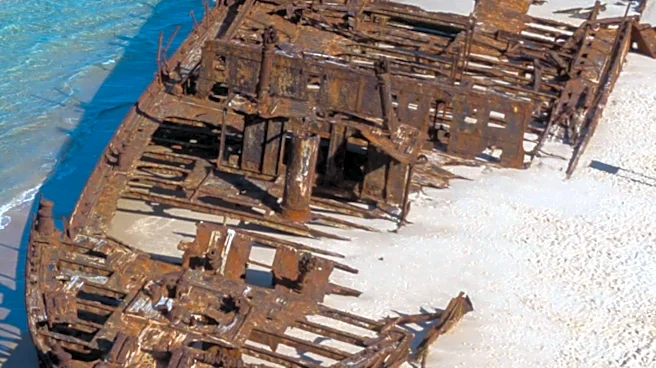
A recent Nor'easter that impacted Nantucket, Massachusetts, has led to the discovery of ship remains on a south shore beach called Point of Breakers. The discovery was made by an island resident who tipped
off Jason Graziadei, editor-in-chief of the Nantucket Current. Graziadei, accompanied by his son, confirmed the presence of newly visible wooden timbers, jutting out of the sand in the shape of a hull. These remains are believed to be from the same ship fragments found in 2022. Following the earlier discovery, David Robinson, director and chief archaeologist for the Massachusetts Board of Underwater Archaeological Resources, conducted research with the Egan Maritime Institute and the Nantucket Historical Association. His findings in 2023 suggested that the wreckage likely belongs to the schooner Warren Sawyer, a cargo ship that crashed near Nantucket on December 22, 1884, while traveling from New Orleans to Boston with cotton and scrap iron. The captain and crew were rescued hours after the crash, and islanders salvaged much of the cargo.
Why It's Important?
This discovery is significant for several reasons, primarily for its contribution to maritime history and local heritage. The uncovering of the Warren Sawyer's remains provides a tangible link to Nantucket's past as a bustling maritime hub, offering insights into 19th-century shipping, trade routes, and the perils faced by seafarers. For archaeologists and historians, it presents a rare opportunity to study a well-preserved shipwreck, potentially yielding valuable information about ship construction, cargo handling, and the daily lives of those aboard. For the local community, it serves as a powerful reminder of their island's rich history and the forces of nature that have shaped its coastline. The fact that these remains were previously covered and are now exposed due to a Nor'easter highlights the dynamic interaction between natural phenomena and historical artifacts, underscoring the transient nature of coastal environments and the potential for future discoveries or re-coverings. It also emphasizes the importance of rapid response and documentation by local media and archaeological teams when such events occur.
What's Next?
Following the re-exposure of the shipwreck, it is highly probable that archaeological teams, including David Robinson and his colleagues from the Massachusetts Board of Underwater Archaeological Resources, will revisit the site. Their immediate next steps will likely involve further documentation, assessment, and potentially stabilization of the exposed timbers to prevent further degradation or loss due to tidal action and subsequent weather events. There may be renewed efforts to conduct more in-depth research, possibly involving excavation or detailed mapping, to confirm the identity of the vessel definitively and to extract any additional artifacts that could shed more light on its history and the circumstances of its sinking. The local community, including the Nantucket Historical Association and the Egan Maritime Institute, will likely play a role in public outreach and education, sharing the story of the Warren Sawyer with residents and visitors. This event could also prompt discussions about long-term preservation strategies for historical sites exposed by climate-related weather phenomena along the U.S. coastline.
Beyond the Headlines
The re-emergence of the Warren Sawyer shipwreck due to a Nor'easter carries deeper implications beyond its historical value. It serves as a stark illustration of how climate change and increasingly severe weather events can impact coastal archaeological sites. As sea levels rise and storms intensify, more submerged or buried historical artifacts may become exposed, presenting both opportunities for discovery and challenges for preservation. This event highlights the urgent need for proactive strategies in coastal heritage management, including comprehensive surveys, rapid response protocols for newly exposed sites, and innovative conservation techniques. Ethically, there's a balance to be struck between scientific study and leaving historical sites undisturbed, especially when natural processes are at play. Culturally, such discoveries can reignite public interest in maritime history and the human stories embedded within these relics, fostering a deeper connection to the past and a greater appreciation for the vulnerability of historical resources in a changing environment. It underscores the idea that history is not static but is continually being revealed and reshaped by natural forces.