
What's Happening?
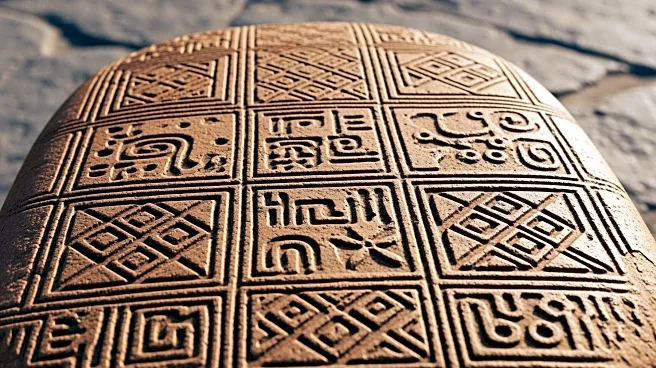
Recent research into Halafian art from 8,000 years ago suggests the existence of a simple mathematical system at the dawn of civilization. The Halafian culture, known for its intricate pottery, existed
in Mesopotamia and was characterized by its geometric designs and botanical motifs. These designs, featuring sequences of numbers like 2, 4, 8, 16, 32, and 64, indicate an early understanding of mathematics. The art reflects a society transitioning from nomadic to settled life, with advancements in agriculture and administration.
Why It's Important?
The discovery of mathematical elements in Halafian art provides insight into the cognitive and cultural development of early human societies. It highlights the role of art as a medium for expressing complex ideas and the evolution of mathematical thought. This finding contributes to our understanding of how early civilizations managed resources and developed administrative systems, laying the groundwork for future advancements in mathematics and science.
Beyond the Headlines
The use of botanical motifs in Halafian art, not linked to fertility rites, suggests a cultural appreciation for aesthetics and complexity. This challenges previous assumptions about prehistoric art being solely functional or ritualistic. The findings also raise questions about the transmission of mathematical knowledge across cultures and its impact on societal development.