




What's Happening?
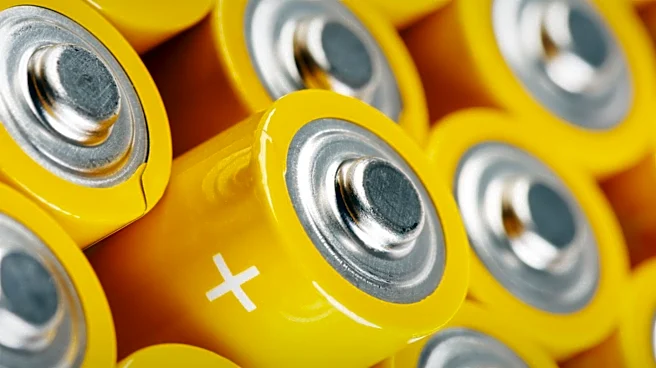
The Trump administration is significantly increasing investment in domestic battery component production and critical mineral processing. This initiative is driven by a growing recognition of batteries' importance for national security, powering artificial
intelligence data centers, and military applications like drones, lasers, and night vision goggles. Despite President Trump's previous skepticism towards electric vehicles and clean energy, his administration views batteries as crucial for various strategic priorities. The Energy Department recently awarded $500 million to seven U.S. companies involved in battery components and critical minerals, while the Pentagon provided a $1.4 billion loan to an advanced battery startup in Washington state. Federal agencies are also funding efforts to produce graphite and lithium domestically. This push aims to reduce the U.S.'s reliance on China, which currently dominates the global supply chain for lithium-ion batteries and associated raw materials.
Why It's Important?
This strategic shift highlights a bipartisan consensus in Washington regarding the critical role of batteries, albeit for different reasons than the previous administration's focus on green energy. The U.S. military's dependence on Chinese components for various battery-powered defense technologies, coupled with China's potential to limit exports of essential battery materials like graphite, poses a significant national security risk. Bolstering domestic production aims to mitigate this vulnerability and prevent China from having a 'choke point' over crucial U.S. industries and defense capabilities. However, experts like Tom Moerenhout of Columbia University's Center on Global Energy Policy note that achieving true supply chain independence from China will be challenging without a robust domestic market for electric vehicles, which are the primary drivers of demand for lithium-ion batteries. The repeal of a $7,500 tax credit for U.S.-made EV components by Republicans in Congress could hinder the growth of this essential demand.
What's Next?
The Trump administration is expected to continue its focus on revitalizing the domestic mining industry and investing in battery manufacturing. This includes further funding initiatives and potential policy changes to encourage U.S. mining and processing of critical minerals. The $1.4 billion loan to Sila Nanotechnologies, a company developing lithium-ion batteries using silicon materials instead of Chinese graphite, indicates a move towards innovative solutions to reduce reliance on foreign materials. However, the company's current production capacity is still a tiny fraction of the global market, suggesting that substantial time and investment will be required to scale up. The ongoing debate between supporting domestic battery production for national security and the broader clean energy agenda, particularly concerning electric vehicles, will likely shape future policy decisions and funding allocations.
Beyond the Headlines
The emphasis on domestic battery production extends beyond immediate economic and national security concerns, touching upon broader geopolitical implications. China's long-term strategy of heavily subsidizing its battery industry and dominating the global supply chain has given it significant leverage. The U.S. effort to counter this dominance reflects a larger trend of strategic competition between the two nations across various technological and industrial sectors. This initiative also raises questions about the environmental impact of increased domestic mining and processing of critical minerals, potentially leading to pushback from environmental groups and Democrats in Congress, who have already raised concerns about some mining deals. The long-term success of this strategy will depend on the U.S.'s ability to not only produce batteries but also to create a sustainable and competitive ecosystem that can rival China's established infrastructure.