

What's Happening?
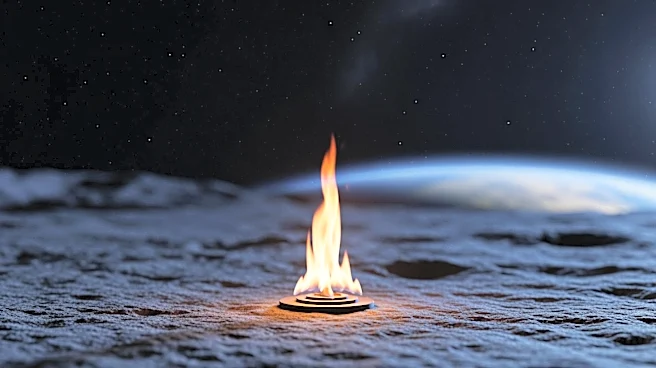
NASA is preparing to conduct the first fire experiment on the Moon to study how flames behave in lunar gravity. This experiment is crucial for understanding the safety of future lunar missions. The agency plans to ignite four solid fuel samples in controlled
environments on the lunar surface, marking the first time such a test will be conducted beyond Earth orbit. The experiment, known as the Flammability Of Materials On The Moon (FM2), is scheduled for a potential launch in late 2026. It will utilize cameras, radiometers, and oxygen sensors to gather detailed data on flame growth, spread, and extinction. This initiative is part of NASA's effort to refine safety standards for spacecraft and habitats, ensuring that future missions are designed with realistic fire behavior in mind.
Why It's Important?
Understanding how fire behaves in lunar gravity is critical for the safety of astronauts and the success of future lunar missions. On Earth, fire behavior is influenced by gravity, oxygen flow, and heat transfer. However, on the Moon, where gravity is only one-sixth of Earth's, these dynamics change, potentially making materials more flammable. This poses a significant risk in sealed lunar habitats, where even a small fire could escalate rapidly. The FM2 experiment aims to provide benchmark data that will help refine safety standards for lunar missions, ensuring that materials used in spacecraft and habitats are safe under lunar conditions. This research is essential as space agencies and private companies plan for long-term human presence on the Moon.
What's Next?
The FM2 experiment is expected to launch in late 2026, and its findings will be crucial for future lunar missions. The data collected will help NASA and other space agencies develop safer materials and protocols for lunar habitats. As the space industry moves towards establishing permanent bases on the Moon, understanding fire behavior in lunar gravity will be vital for designing safe living and working environments for astronauts. The results of this experiment could influence everything from construction materials to emergency protocols, shaping the future of human habitation on the Moon.
Beyond the Headlines
The FM2 experiment highlights the challenges of applying Earth-based engineering standards to extraterrestrial environments. Previous experiments in microgravity have shown that flames behave differently, often forming spherical shapes and burning at lower temperatures. These findings have already forced engineers to rethink fire suppression strategies. The unique conditions on the Moon, including altered gravity and oxygen-rich atmospheres, create a potentially hazardous environment that has never been fully studied in real-world conditions. This research underscores the importance of validating safety standards under actual lunar conditions, ensuring that future missions are prepared for the unique challenges of living and working on the Moon.