





What's Happening?
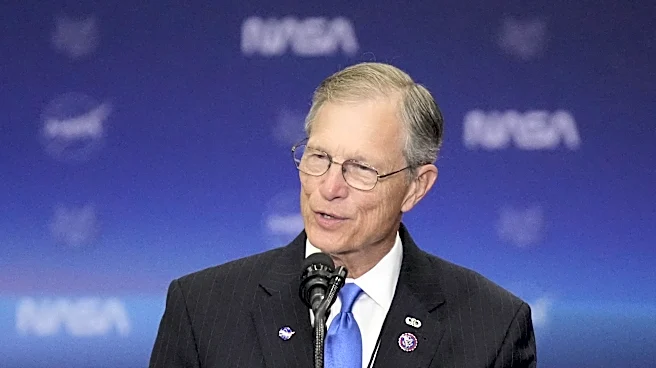
The Senate Appropriations Committee's Commerce-Justice-Science (CJS) subcommittee has proposed $24.874 billion for NASA in Fiscal Year 2027. This figure is slightly higher than the $24.438 billion approved for FY2026 and significantly exceeds the $18.8
billion requested by the President Trump Administration for FY2027. The CJS bill also funds the Department of Commerce, the Department of Justice, and the National Science Foundation. The subcommittee's report noted that NASA's recent major reorganization of mission directorates and budget structure occurred too late and lacked sufficient detail to be fully incorporated into this bill. The House Appropriations Committee had previously approved its version of the CJS bill, recommending $24.4 billion for NASA, also rejecting the Administration's proposed cuts.
Why It's Important?
This proposed funding level signals strong bipartisan support in Congress for NASA's programs, particularly in contrast to the President Trump Administration's lower request. Maintaining or increasing NASA's budget is crucial for the U.S. to sustain its leadership in space exploration, scientific research, and technological innovation. Adequate funding ensures the continuity of critical missions, supports the aerospace industry, and fosters job creation. The Senate subcommittee's emphasis on integrating the Mars Sample Return (MSR) mission into the Moon-to-Mars program as a proving ground for human exploration highlights a strategic vision for future human spaceflight. This funding decision directly impacts the pace and scope of U.S. space endeavors, affecting scientific discovery, national prestige, and the development of advanced technologies with terrestrial applications.
What's Next?
The Senate Appropriations Committee has yet to announce a schedule for the full committee to consider the subcommittee's recommendations. Following this, the bill would need to pass the full Senate and then be reconciled with the House version of the CJS bill. Given that none of the 12 FY2027 appropriations bills have cleared Congress yet, and the government is currently operating under a Continuing Resolution expiring on December 11, there will be further negotiations. The differing funding levels and priorities between the Senate, House, and the President Trump Administration will require compromise to finalize the budget. The future of NASA's reorganization and how it will be integrated into subsequent budget cycles will also be a key point of discussion.
Beyond the Headlines
The divergence between congressional appropriations and the President Trump Administration's budget request for NASA reflects a broader political dynamic regarding federal spending priorities and the role of scientific agencies. While the Administration may prioritize fiscal conservatism or reallocate funds to other areas, Congress often champions long-term investments in science and technology, recognizing their strategic importance. This ongoing tension highlights the checks and balances inherent in the U.S. budgetary process. The specific directive to integrate the Mars Sample Return mission into the Moon-to-Mars program also suggests a strategic shift in how Congress views the synergy between robotic and human exploration, potentially influencing NASA's long-term mission planning and resource allocation. This could lead to a more integrated and efficient approach to space exploration, but also raises questions about the balance between pure scientific inquiry and human exploration objectives.