




What's Happening?
Sabrina Pasterski, a theoretical physicist often dubbed the "new Einstein," is currently leading the Celestial Holography Initiative at the Perimeter Institute for Theoretical Physics in Canada. At 33 years old, Pasterski is also the vice-director of an international
collaboration in this research area, supported by the Simons Foundation. Her work focuses on celestial holography, a field of theoretical physics that explores the possibility of describing the universe using one fewer dimension than currently known. This concept is rooted in the holographic principle, which suggests that information within a region of space could be represented on its boundary surface. Pasterski's academic journey is notable; she built a small airplane at age 12, graduated from MIT in three years with the highest GPA in her class, and completed her doctorate at Harvard under the supervision of Andrew Strominger.
Why It's Important?
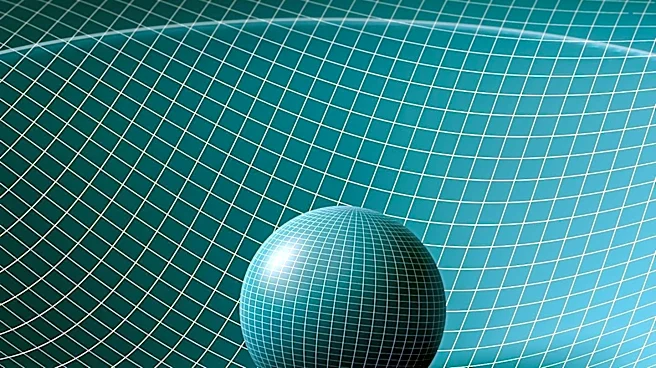
Pasterski's research into celestial holography holds significant importance for the U.S. and global scientific community. Her efforts, alongside international collaborators, aim to reconcile general relativity and quantum mechanics—two fundamental pillars of physics that remain ununified. A successful breakthrough in this area could revolutionize our understanding of gravity and spacetime, potentially leading to new technological advancements and a deeper comprehension of the universe's fundamental laws. The Simons Foundation's support for this international collaboration underscores the global recognition of the potential impact of this research. For the U.S., fostering such high-level scientific inquiry contributes to its standing as a leader in theoretical physics and could attract further talent and investment in scientific research.
What's Next?
The research into celestial holography is ongoing, and Pasterski's theory is still in development, requiring further validation and experimental confirmation. The next steps involve continued theoretical work and collaborative efforts with international research groups to overcome existing obstacles. If successful, this research could lead to a paradigm shift in physics, potentially influencing future space exploration, quantum computing, and other advanced scientific fields. The scientific community will be closely watching for new findings and potential experimental setups that could provide evidence for the theory. Continued funding and international cooperation will be crucial for the advancement of this ambitious project.
Beyond the Headlines
The moniker "new Einstein" highlights the immense potential and public interest surrounding Pasterski's work, but it also underscores the pressure and high expectations placed on young, brilliant scientists. Her early achievements, such as building an airplane and excelling at MIT, exemplify a rare combination of theoretical prowess and practical ingenuity. The pursuit of celestial holography touches upon profound philosophical questions about the nature of reality and dimensions, pushing the boundaries of human understanding. This research also emphasizes the increasing importance of international scientific collaboration in tackling complex global challenges and fundamental scientific mysteries, moving beyond national borders to advance collective knowledge.