



What's Happening?
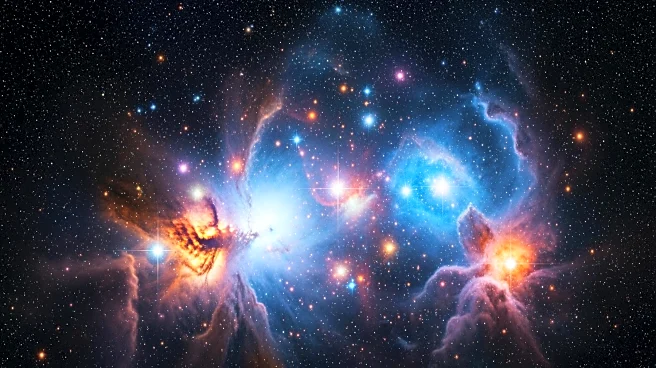
Astronomers have identified a vast star-forming region known as NGC 2264, located approximately 2,700 light-years from Earth in the constellation Monoceros. This region, often referred to as the Christmas Tree Cluster, is notable for its intricate mix
of glowing clouds and young stars. The area is shaped by interstellar gas and dust, which are the raw materials for star formation. As new stars ignite, they emit energy that causes nearby gas to glow, creating emission nebulae. The region also features dark dust clouds that block starlight, creating shadows, and reflection nebulae where dust reflects light from nearby stars. Key features include the Cone Nebula and the Fox Fur Nebula, which contribute to the region's distinctive appearance.
Why It's Important?
The discovery and study of NGC 2264 provide valuable insights into the processes of star formation and the structure of our galaxy. Understanding these regions helps astronomers learn more about the life cycle of stars and the conditions that lead to their formation. The Christmas Tree Cluster's visibility from Earth at certain times of the year makes it an important subject for both professional astronomers and amateur skywatchers. The study of such regions can also inform broader astrophysical theories and models, contributing to our understanding of the universe's evolution.
What's Next?
Further observations and studies of NGC 2264 are likely to continue, utilizing both ground-based telescopes and space observatories. These efforts will aim to gather more detailed data on the composition and dynamics of the region. As technology advances, astronomers may be able to observe these star-forming processes in even greater detail, potentially leading to new discoveries about the mechanisms driving star formation. Collaborative efforts among international space agencies and research institutions will be crucial in advancing our understanding of such cosmic phenomena.
Beyond the Headlines
The study of NGC 2264 and similar regions also raises questions about the potential for life elsewhere in the universe. By understanding the conditions under which stars and planetary systems form, scientists can better assess the likelihood of habitable environments beyond our solar system. Additionally, the cultural and educational impact of such discoveries is significant, as they inspire public interest in astronomy and science, encouraging future generations to explore the cosmos.