




What's Happening?
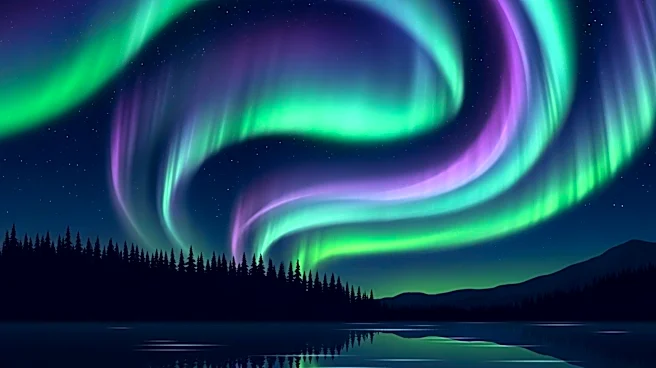
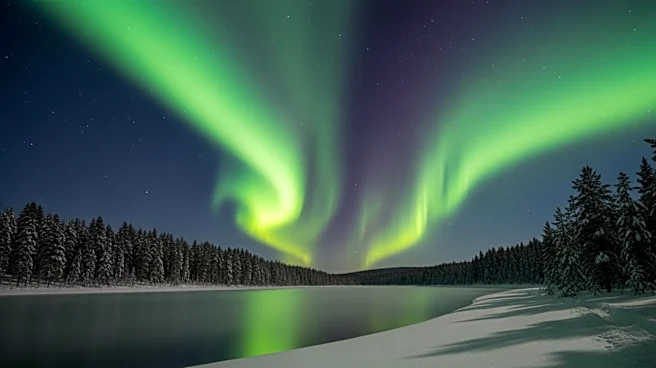
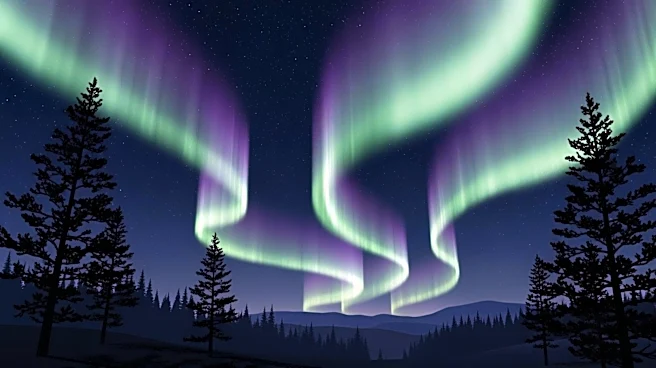
The National Oceanic and Atmospheric Administration (NOAA) has forecasted that nearly one-third of the United States could witness the aurora borealis due to a geomagnetic storm. This rare event is expected to be visible across 18 states, including Alaska,
Idaho, Illinois, and Oregon, as solar winds hit Earth at speeds of up to 430 miles per second. The auroras, typically seen in Arctic regions, are predicted to be visible as far south as Illinois and Oregon. NOAA provides maps on its website to assist those interested in viewing the phenomenon, which is expected to be most visible between 5 p.m. EDT on April 17 and 2 a.m. EDT on April 18.
Why It's Important?
The visibility of the aurora borealis in such southern latitudes is a rare occurrence, offering a unique opportunity for millions of Americans to experience this natural spectacle. The geomagnetic conditions that cause the auroras can impact essential technologies, including HF radio communication and GPS satellite navigation. This event highlights the importance of space weather awareness, as it can affect electric transmission and other technological systems. The widespread visibility of the auroras could also boost interest in space weather phenomena and encourage public engagement with scientific observations.
What's Next?
As the geomagnetic storm progresses, NOAA will continue to monitor and update forecasts to provide accurate predictions of aurora visibility. Stargazers are advised to find locations with minimal light pollution and clear views of the northern horizon to maximize their chances of seeing the auroras. The event may prompt further studies into the effects of solar winds on Earth's magnetic field and technological systems. Additionally, the increased public interest could lead to more educational initiatives about space weather and its impacts.