



What's Happening?
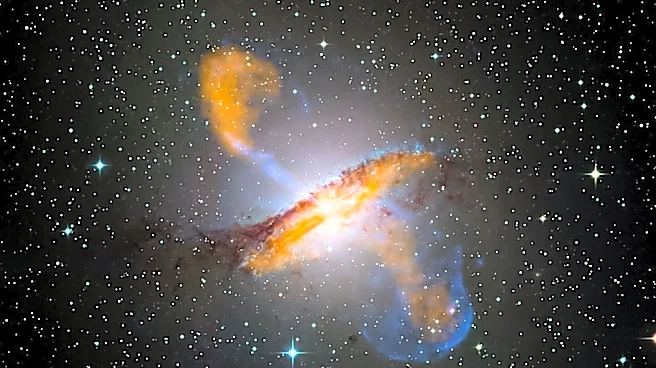
Astronomers at the University of Würzburg have utilized a computer simulation to replicate the appearance of the black hole jet in the nearby galaxy Centaurus A, as observed by the Event Horizon Telescope. The simulation, detailed in a study published
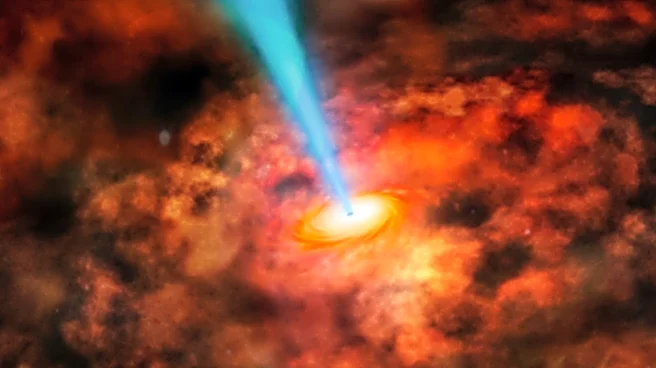
in Astronomy & Astrophysics, indicates that the jet's edges glow more brightly than its center. This phenomenon, known as edge brightening or limb brightening, is attributed to electrons predominantly moving along magnetic field lines rather than in all directions. Centaurus A, located approximately 12 million light-years from Earth, hosts the closest radio galaxy to our planet. The Event Horizon Telescope, a global network of radio dishes, captured an image of its jet base in 2021, which showed emission concentrated along the outer edges. The new model fits a physical explanation to this observation, suggesting that electrons in the dilute, strongly magnetized central spine of the jet lose energy faster, and those moving along magnetic field lines radiate less towards the observer from the spine, shifting brightness to the surrounding sheath at the jet's borders.
Why It's Important?
This research provides critical insights into the physics of relativistic jets emanating from supermassive black holes, which are powerful phenomena that significantly influence galaxy evolution. Understanding why these jets exhibit edge brightening helps refine our models of how black holes interact with their environments and accelerate particles to extreme energies. The study's finding that electron movement is anisotropic—meaning pressure across magnetic field lines is significantly weaker than along them—is a key ingredient in explaining the observed brightness distribution. This departure from isotropic electron movement suggests specific mechanisms at play within the jet. Furthermore, the simulation's ability to reproduce the Event Horizon Telescope's observations strengthens the validity of the physical models used and offers a 'closest window into the physics of relativistic jets,' according to lead author Glaser. This improved understanding contributes to the broader field of astrophysics, particularly in the study of active galactic nuclei and their impact on cosmic structures.
What's Next?
The Würzburg study's model, while successful in reproducing the edge-brightened appearance of the Centaurus A jet, also highlights several open questions and limitations. The best-fit model implies a viewing angle of about 72 degrees, which is larger than some previous estimates, suggesting a potential bend in the jet that requires further investigation. Discrepancies remain in the data near 3.5 gigalambda on baselines involving the Large Millimeter Telescope, indicating that the jet base might be more compact than observed images suggest, and the model shows a lower polarization fraction. Future steps include exploring a denser ambient medium, alternative magnetic field shapes, and utilizing an expanded Event Horizon Telescope array. The model also predicts that the black hole's shadow in Centaurus A should become visible at approximately 3 terahertz, a frequency that would necessitate higher-resolution instruments like the proposed space-based interferometers BHEX and SHARP. On the ground, the National Radio Astronomy Observatory is developing a pathfinder for a next-generation array of 263 antennas, and the Square Kilometre Array is also planning early science verification for its low-frequency array.
Beyond the Headlines
The detailed study of black hole jets, such as those in Centaurus A, extends beyond mere astronomical observation; it delves into fundamental physics. The role of magnetic reconnection, where magnetic field lines break and rejoin, releasing stored energy and accelerating charged particles, is a compelling hypothesis for the observed electron anisotropy. This process is not only relevant to black hole jets but also to phenomena like solar flares and laboratory plasma experiments, suggesting universal principles governing energy release in magnetized plasmas. The ongoing efforts to image black hole shadows and understand their jets push the boundaries of observational astronomy and theoretical physics, potentially leading to new insights into gravity, spacetime, and the extreme conditions near black holes. These investigations contribute to a deeper understanding of the universe's most energetic processes and the fundamental laws that govern them, inspiring future generations of scientists and engineers.