



What's Happening?
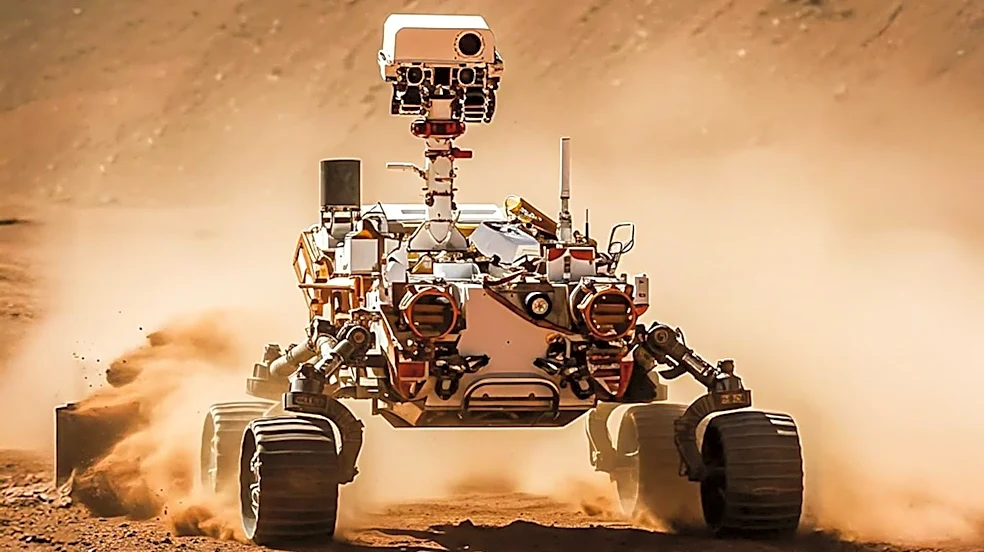
NASA's Perseverance Mars rover has set a new record for the farthest distance driven by any vehicle on the surface of another world. On October 11, the rover reached a total distance of 28.10 miles, surpassing the previous record of 28.06 miles held by NASA’s
Opportunity rover. This milestone occurred as Perseverance was traveling towards an area named 'Idubi,' located off the western rim of Jezero Crater. The rover's current mission involves investigating what may be some of the oldest terrain ever explored in the solar system, with a primary goal of finding traces of ancient hydrothermal systems. The Perseverance rover utilizes an autonomous navigation system, known as AutoNav, which allows it to capture images of the terrain while in motion, construct 3-D maps of potential hazards, and plot its own course between waypoints designated by planners on Earth. This achievement marks three decades of NASA rover operations on Mars, highlighting significant advancements in robotic exploration capabilities.
Why It's Important?
This record-breaking achievement by the Perseverance rover signifies a major leap in robotic planetary exploration and engineering. The ability of the rover to cover such extensive distances autonomously enhances the scope and efficiency of scientific missions on other celestial bodies. By exploring ancient terrains and searching for hydrothermal systems, Perseverance is contributing crucial data that could shed light on Mars' past habitability and the potential for ancient microbial life. The advanced AutoNav system, which has been used for over 90% of Perseverance's total driving distance, demonstrates the increasing sophistication of AI and automation in space exploration. This technology reduces the need for constant human intervention, allowing for more ground to be covered and more scientific data to be collected in less time. The success of Perseverance also reinforces the U.S.'s leadership in space technology and scientific discovery, inspiring future generations of engineers and scientists.
What's Next?
NASA anticipates that the Perseverance rover will continue to extend its driving record for many years to come, as all its mobility systems remain fully operational. The rover will proceed with its exploration of the 'Idubi' region and other ancient terrains within Jezero Crater, focusing on its primary objective of identifying evidence of past hydrothermal activity. Future software enhancements are planned to further improve the rover's autonomous capabilities, such as teaching it to navigate more efficiently by steering less and rolling more, and to self-correct its position using orbital maps mid-drive. Researchers are also working on enabling the rover to overcome challenges like sun glare in its navigation cameras, which would allow for longer operational days. The data collected by Perseverance will continue to be analyzed by scientists globally, contributing to a deeper understanding of Martian geology and astrobiology, and informing future human and robotic missions to Mars.
Beyond the Headlines
The extended operational lifespan and record-breaking performance of the Perseverance rover underscore a broader trend in space exploration: the increasing reliance on durable, autonomous robotic systems for long-duration missions. This success has implications beyond Mars exploration, potentially influencing the design and execution of missions to other distant celestial bodies where direct human control is impractical. The continuous refinement of autonomous navigation and decision-making capabilities in rovers like Perseverance could pave the way for more complex robotic missions, including sample returns from challenging environments or the establishment of preliminary infrastructure for human outposts. Ethically, the data gathered about Mars' past habitability could reignite debates about planetary protection and the potential for extant life, emphasizing the responsibility of space agencies to prevent contamination. This mission also serves as a powerful symbol of international scientific collaboration and human ingenuity in pushing the boundaries of knowledge.