






What's Happening?
American journalist and essayist Fareed Zakaria stated that "the decisive weapon of the next decade will not be a hypersonic missile," but rather the algorithm, emphasizing the transformative role of Artificial Intelligence (AI) in modern warfare and maritime
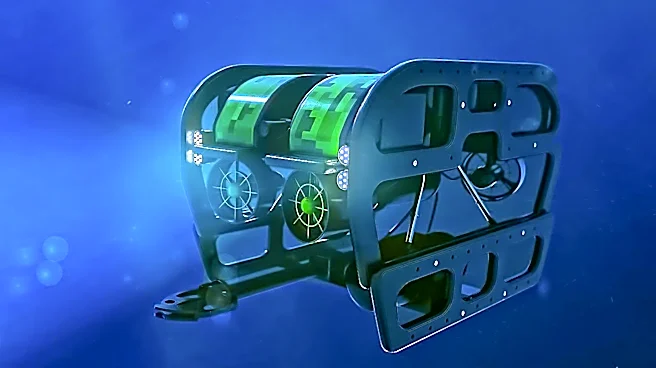
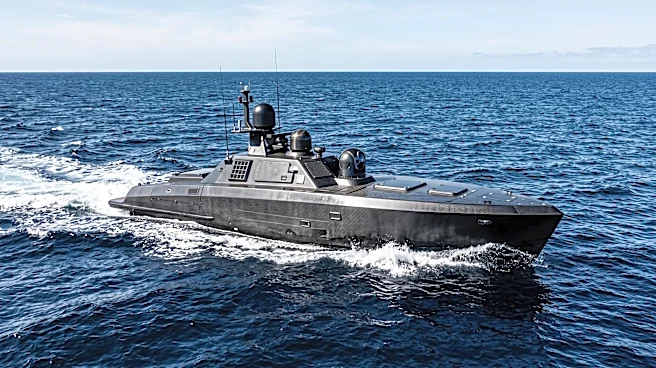
security. This assertion was made during a debate where the impact of AI on naval power was discussed. Traditionally measured by tonnage and armor, naval power is now being redefined by autonomous drones, cyberattacks, and unmanned vessels. AI's capabilities extend to maritime surveillance, where it can analyze vast amounts of data from radars, sonars, satellites, and commercial tracking systems to identify suspicious activities, even when vessels attempt to evade detection by disabling transponders. This technological shift allows for the detection of illicit activities like oil smuggling or illegal fishing.
Why It's Important?
The shift towards AI as a decisive weapon has profound implications for global security and the balance of power. Zakaria's statement underscores a fundamental change in military strategy, moving from traditional hardware-centric approaches to data-driven, algorithmic warfare. This transformation means that nations with advanced AI capabilities could gain a significant advantage, potentially disrupting existing geopolitical dynamics. For the U.S., investing in and developing robust AI defenses and offensive capabilities becomes paramount to maintaining its strategic position. The vulnerability of critical infrastructure, such as submarine cables that carry over 99% of intercontinental data, to AI-powered cyberattacks highlights the need for enhanced cybersecurity measures. The rise of unmanned vessels also presents both opportunities for cost-effective surveillance and challenges in terms of ethical considerations and the potential for unintended escalation.
What's Next?
The increasing integration of AI into maritime security and warfare necessitates a re-evaluation of international regulations and ethical guidelines. As machines gain autonomy, discussions will intensify regarding human oversight, accountability, and verification mechanisms for AI-driven decisions. The United Nations, as mentioned in the source, is already addressing these technological revolutions, with the International Maritime Organization adopting a non-binding global code for autonomous vessels. Future steps will likely involve efforts to establish more comprehensive and legally binding international agreements to govern the use of AI in military contexts. There is also a risk of a technological divide emerging between states capable of mastering these tools and those dependent on systems they cannot control, potentially leading to new forms of global inequality and instability. The ongoing technological race will require continuous adaptation and strategic planning from major powers.
Beyond the Headlines
Beyond the immediate military and security implications, the rise of AI as a decisive weapon raises deeper ethical and philosophical questions about the nature of conflict and human control. The potential for algorithms to be manipulated or 'poisoned' to mislead systems, as Zakaria warned, introduces a new layer of complexity and risk. This could lead to scenarios where AI systems misidentify targets or ignore threats, with potentially catastrophic consequences. The acceleration of automated decisions also increases the risk of errors, misjudgments, and unintended escalation, challenging traditional notions of command responsibility. Furthermore, the reliance on AI could lead to a dehumanization of warfare, where decisions are made by machines rather than humans, potentially lowering the threshold for conflict. Society must grapple with the moral implications of delegating significant power to autonomous systems and ensure that technology serves humanity, rather than the other way around.