



What's Happening?
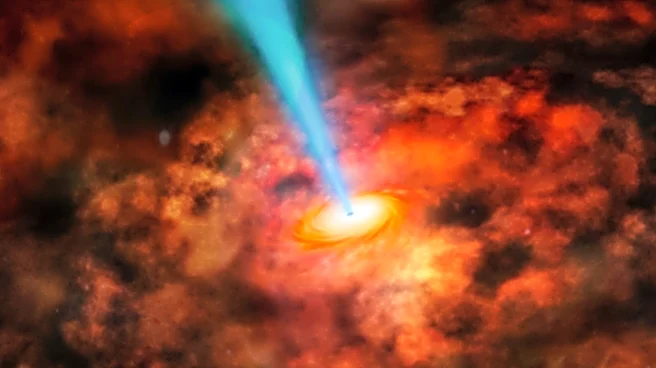
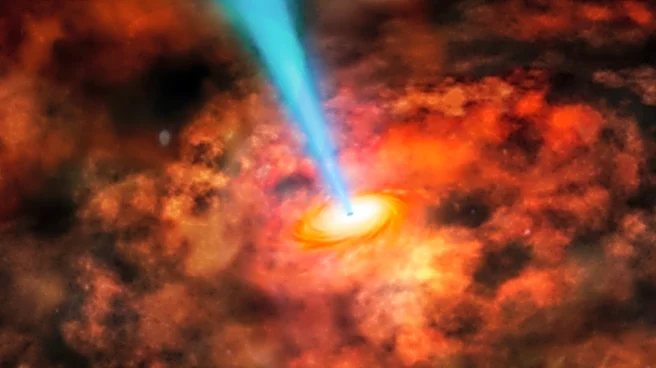
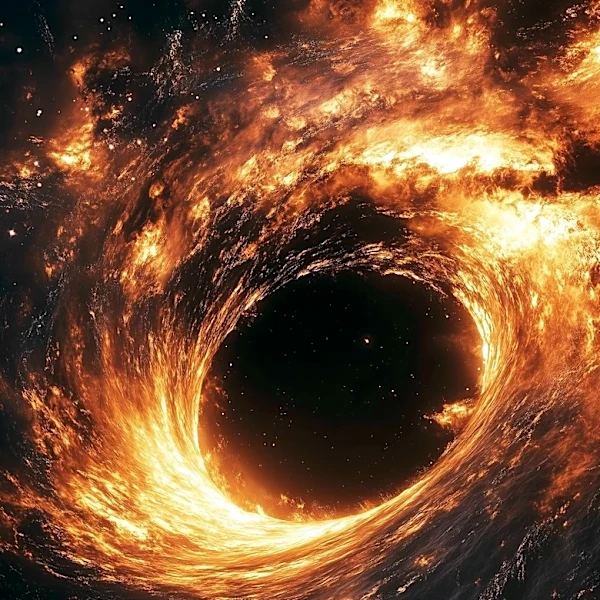
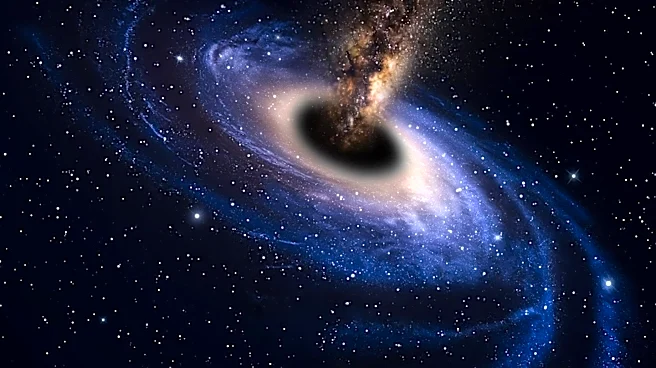
Astronomers have identified a supermassive black hole, approximately 1.1 billion times the Sun’s mass, at the center of the red quasar J1440+0019. This quasar, located at a redshift of z ≈ 6.55, dates back to an era when the Universe was less than 1 billion years
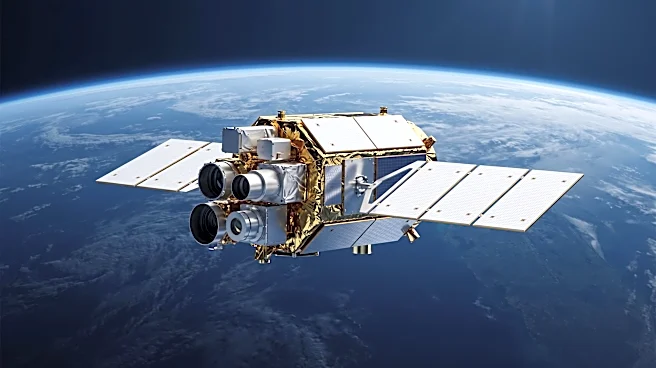
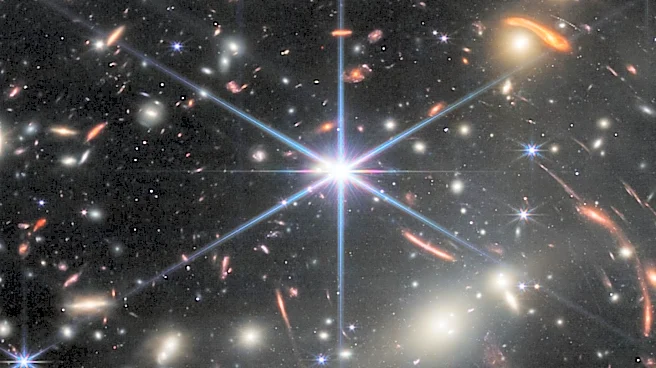
old. The black hole is rapidly consuming surrounding matter, radiating at about 80% of its Eddington luminosity limit, which indicates an exceptionally high accretion rate. The discovery was made by a team led by Daming Yang of Leiden Observatory, utilizing the James Webb Space Telescope’s NIRSpec infrared spectrograph and the ALMA radio interferometer. The quasar is notable for being hidden within a dusty cocoon, a characteristic of 'obscured' active galactic nuclei that are difficult to detect through conventional ultraviolet light methods. Spectral analysis revealed dust attenuation typical of type 1 red quasars and high-speed nuclear outflows reaching 3,600 km/s. The host galaxy is also a significant source of ionized carbon emission at high redshifts, containing an estimated 400 million solar masses of dust and a star formation rate of up to 1,330 Sun-like stars per year.
Why It's Important?
This discovery is crucial for understanding the early Universe, particularly the epoch of cosmic reionization, which occurred between 600 million and 1 billion years after the Big Bang. Studying such early and rapidly growing supermassive black holes helps refine the timeline and processes of how the first stars and galaxies ionized neutral hydrogen. The detection of J1440+0019, an obscured quasar, highlights the limitations of previous ultraviolet-based surveys and suggests that a substantial proportion of early active galactic nuclei might have been missed. The efficiency of using instruments like JWST and ALMA to identify these dusty quasar candidates opens new avenues for building a more complete catalog of such objects, which is vital for comprehending the co-evolution of galaxies and their central black holes in the nascent cosmos. The high accretion rate and significant dust content provide insights into the extreme conditions and rapid growth mechanisms present in the early Universe, challenging existing models of black hole and galaxy formation.
What's Next?
Future research will likely focus on expanding the catalog of similar obscured quasars using new space telescopes like Euclid and Roman, which are expected to enhance the identification of such objects. Further analysis of J1440+0019 and other early Universe quasars will aim to refine the understanding of their dust composition, outflow mechanisms, and the precise rates of matter accretion. Astronomers will continue to investigate the broad range of properties and accretion states exhibited by red objects in the early Universe to develop more comprehensive models of cosmic evolution. The methodology employed in this study, combining infrared spectrography and radio interferometry, will serve as a blueprint for future observations, potentially leading to the discovery of more hidden cosmic giants and a deeper understanding of the processes that shaped the Universe in its infancy.
Beyond the Headlines
The existence of such massive black holes so early in the Universe challenges current theories of black hole growth, which struggle to explain how they could have accumulated so much mass in such a short period. This 'dusty cocoon' phenomenon also points to the possibility that the early Universe was far more opaque than previously assumed, potentially altering our understanding of light propagation and observational biases. The high star formation rates in the host galaxy suggest a strong interplay between the central supermassive black hole and its galactic environment, where the black hole's activity might either fuel or quench star formation. This interplay is a critical area of study, as it dictates the evolution of galaxies. The discovery also underscores the power of advanced observational technologies like JWST and ALMA in pushing the boundaries of cosmic exploration, revealing phenomena that were previously undetectable and forcing a re-evaluation of fundamental cosmological models.