





What's Happening?
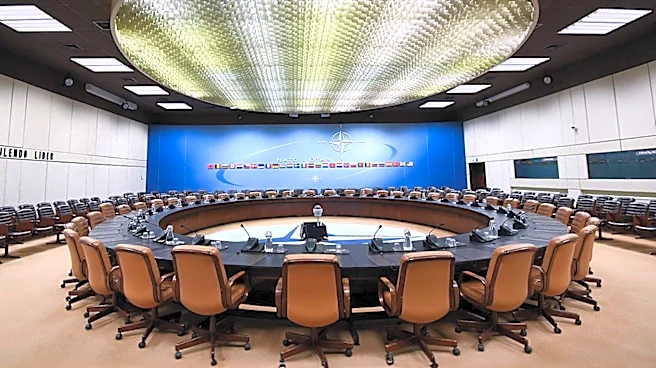
NATO Secretary General Mark Rutte has addressed the need for European and Canadian allies to increase their defense burden, particularly as the United States may face simultaneous crises in multiple theaters. This discussion is framed within the context
of the 2026 National Defense Strategy, which identifies a 'simultaneity problem' where the U.S. could face significant military demands across several regions concurrently. Rutte emphasized that stronger European forces could maintain territory and secure reinforcement routes, allowing Washington more flexibility in deploying additional capacity. General Alexus Grynkewich, NATO’s Supreme Allied Commander Europe (SACEUR), further elaborated on a 'theory of victory' involving a 'block, blunt, and break' sequence, aiming to deny rapid seizure of allied territory, prevent offensive momentum, and dismantle the attacking military system. This approach seeks to create time for additional power to accumulate and for Washington to assess evolving crises.
Why It's Important?
This shift in NATO's defense strategy has significant implications for U.S. foreign policy and military commitments. By encouraging European and Canadian allies to take on a greater share of their own defense, the U.S. aims to mitigate the 'simultaneity problem' and maintain its global reach while being more selective about permanent military deployments. This redistribution of responsibility could allow the U.S. to retain more forces available for rapid deployment to other critical regions, such as the Indo-Pacific. However, the effectiveness of this strategy hinges on the capabilities of allied forces, particularly in areas like air defense, intelligence, surveillance, reconnaissance (ISR), strategic lift, and command-and-control, which remain unevenly distributed. The credibility of U.S. commitments to its allies will be crucial, as their willingness to withstand initial pressures depends on their belief that American support will arrive when needed.
What's Next?
The ongoing discussions within NATO suggest a continued push for European and Canadian allies to enhance their defense capabilities and assume greater responsibility for regional security. Future efforts will likely focus on addressing the existing gaps in allied military capabilities, particularly in critical areas such as air defense and intelligence. The implementation of the 'block, blunt, and break' strategy will require further development and adaptation to different regional contexts, as geography, available forces, and types of attacks vary. The U.S. will likely continue to assess how this distributed strategic depth impacts its ability to respond to crises globally, balancing its commitments with the need for flexibility and strategic reserves. The success of this approach will depend on sustained investment by allies in their defense and the continued credibility of U.S. security guarantees.
Beyond the Headlines
The evolving NATO strategy reflects a broader re-evaluation of American primacy and the sustainability of its global military footprint. The concept of 'distributed strategic depth' suggests a move towards a more nuanced form of engagement, where the U.S. seeks to leverage allied capabilities to absorb initial pressures, thereby gaining time to make strategic decisions. This could lead to a more agile and responsive U.S. military, but it also places a greater burden on allies, potentially testing the cohesion and interoperability of the alliance. The reliance on American 'enablers'—such as intelligence, transport, and command systems—highlights a potential vulnerability, as disruption to these systems could weaken regional defenses even with stronger local forces. This raises questions about the long-term resilience of the alliance's defense architecture and the need for allies to develop more independent capabilities.